


Discover the most outstanding articles in all topics of life.
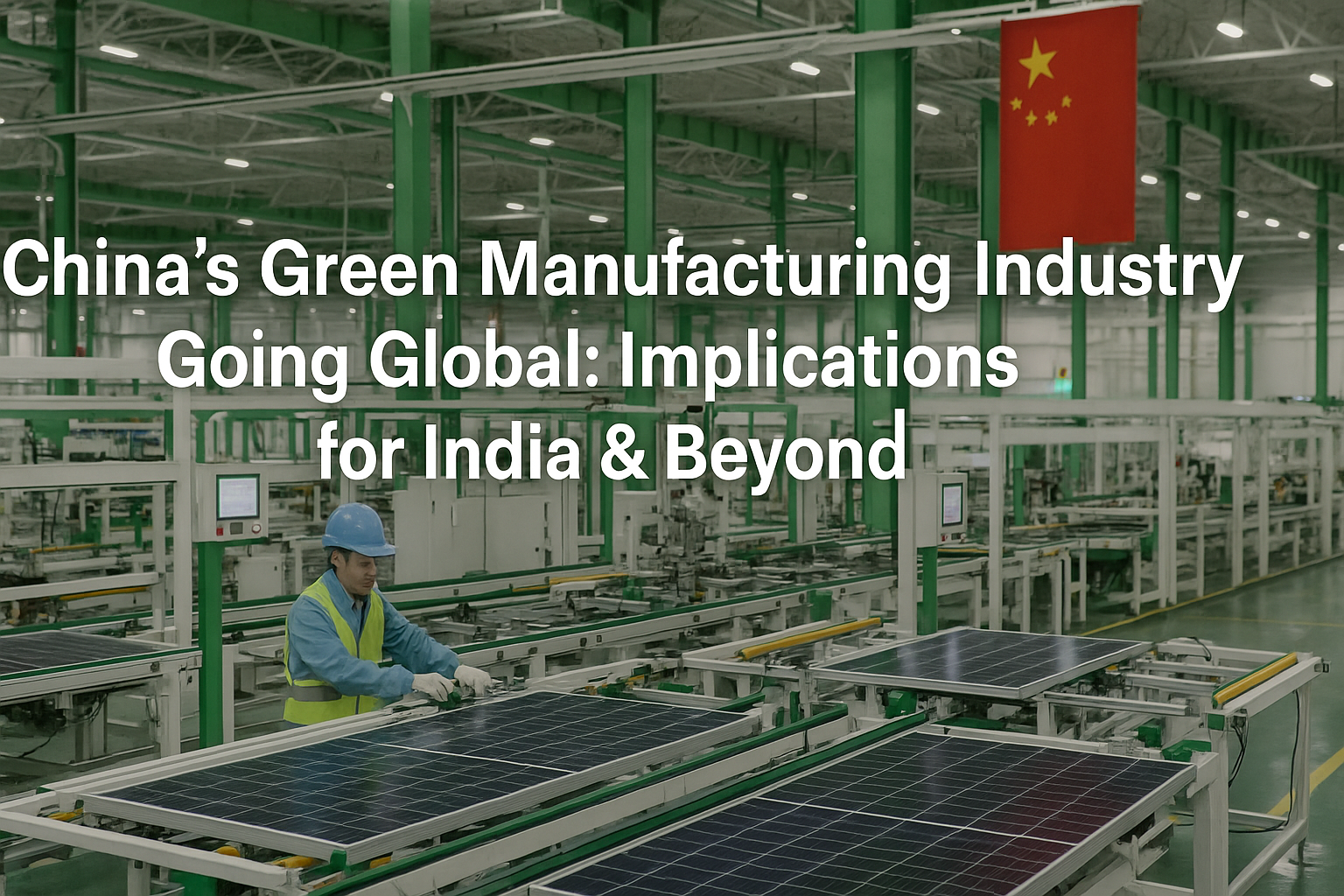
IntroductionThe global green-technology manufacturing landscape is undergoing a profound shift. According to a recent report by Energy Tracker Asia, Chinese green-tech manufacturers have expanded overseas investment into 54 countries, signalling that the country’s manufacturing ambitions are not just domestic but global. For India, which is itself accelerating its renewable manufacturing roadmap, this development offers both strategic opportunities and competitive challenges.In this article, we explore how China’s green manufacturing expansion is playing out, what is driving it, what regions are attracting the investments, and what India (and other emerging markets) can learn and respond to.Policy & Strategic Drivers of China’s Green Manufacturing PushSeveral underlying drivers explain China’s global green-manufacturing ramp-up: China’s ambition to anchor itself in the full green-tech value chain—from raw materials to final manufacturing—has long been visible via initiatives such as Made in China 2025, which emphasises green and sustainable production. As domestic growth moderates and competition intensifies, Chinese manufacturers are seeking overseas locations with cost advantages, regional access and favourable export logistics. The database report emphasises that these are three key motivations: access to host-country markets, access to third-country markets and access to raw materials. Policy instruments: China has set targets requiring more industries to step up their use of green power, signalling that manufacturing sectors will increasingly rely on renewables, further aligning manufacturing growth with the energy transition. Global supply chain strategy: By extending manufacturing overseas, Chinese firms build resilience, diversify risk (including trade/tariff risk) and enable closer access to growth markets. Investment Flows, Key Regions & TechnologiesThe Energy Tracker Asia report reveals several notable investment patterns: Chinese green-technology manufacturers have committed over USD 57 billion into 135 overseas solar manufacturing projects alone. ASEAN remains the main destination. ASEAN countries (Indonesia, Vietnam, Malaysia, Thailand) have been top-receivers historically, due to their cost base, proximity to Chinese supply chains and re-export role. However, the pattern is shifting: by 2024 the ASEAN share of project-counts dropped, with regions such as MENA (Middle East & North Africa) growing rapidly—MENA projects surged from near zero in 2021 to over 20% of total investments in 2024. The investment spread covers multiple technologies: solar modules, EV manufacturing, wind-equipment manufacturing, battery systems. Other sources suggest Chinese firms have committed more than USD 210 billion to green-tech manufacturing since 2022 (across 461 projects in 53 countries) The strategy is clearly global: Chinese green-tech manufacturing isn’t just domestic, it is increasingly embedded in overseas production hubs and export networks. Implications for India & Key LearningsFor India, which is pushing hard on renewable manufacturing (solar modules, electrolyser/green hydrogen, batteries, EVs), the unfolding Chinese strategy offers important implications:Opportunities: India can partner with Chinese-backed supply-chains: Some Chinese firms may seek Indian locations either as manufacturing anchors or export hubs—especially given India’s market size and favourable policy push. Learning curve: The speed, scale and integration achieved by Chinese firms offers lessons in how to build manufacturing clusters, integrate raw materials, and build export-oriented production. Export-hub potential: India could position itself as a competing hub for green-tech exports, especially to neighbouring regions (South Asia, Africa) if it builds cost-competitiveness and favourable trade frameworks. Challenges/Competitive Risks: China’s scale advantage and entrenched supply‐chains may crowd out nascent players in India unless India finds differentiated niches or aggressively pursues incentives. As Chinese firms revisit geographic diversification (e.g., MENA, Central Asia) India must accelerate its manufacturing-ecosystem build-out. Raw‐material access, cost pressures, and supply-chain dependencies remain hurdles for Indian manufacturing; Chinese firms already have strong integration upstream and overseas. Trade/tariff and origin rules: Chinese overseas manufacturing can circumvent some export restrictions, while Indian firms need to navigate global trade regimes carefully. What India Should Emphasise: Strengthen upstream raw‐materials processing and refine critical minerals, to reduce dependence on imports. Create clusters with integrated ecosystems (modules, batteries, assembly) and link to export markets. Strengthen FDI openness, trade agreements and export-oriented manufacturing incentives to attract global green-tech supply-chains. Focus on differentiated manufacturing segments (e.g., advanced battery chemistries, next-gen electrolysers, specialist EV components) rather than solely competing on cost. Monitor China’s overseas moves to pre-empt where manufacturing is relocating, and consider Indian states/regions as viable magnets for such investment. Risks, Overcapacity and Strategic ConcernsIt’s not all smooth sailing for China either. Some of the risks that Indian and global observers should note: Overcapacity: Reports flag concerns that rapid build-out of green manufacturing may generate oversupply, price pressure and margin squeeze. Circular trade and geopolitics: China’s overseas manufacturing expansion intersects with trade tensions, rules of origin and export-controls (for example from US/EU). The diversification into other regions reflects this. Environmental and energy-footprint: While manufacturing green tech is positive, the manufacturing process is still energy and resource intensive—and in many cases powered by coal. This paradox may slow climate gains. Strategic dependency: Countries hosting Chinese green-tech manufacturing may become dependent on Chinese supply-chains. India must weigh this balance carefully. Future OutlookLooking ahead: China’s overseas green manufacturing drive is set to continue, though perhaps with a shift from pure volume expansion to consolidation. The Energy Tracker report notes a “cooling” in the overseas build-out in early 2025, suggesting consolidation rather than acceleration. For India, the window is now: As global supply-chains evolve, Indian policy and manufacturing investment need to keep pace. The “green-manufacturing race” is increasingly global and location-sensitive. Collaboration models may become more common: instead of pure competition, joint ventures, supply-chain partnerships and regional manufacturing hubs (e.g., India-Africa, India-Southeast Asia) could emerge. ConclusionChina’s green-technology manufacturing expansion is not just a domestic story—its global tentacles are reshaping supply‐chains, regional manufacturing hubs and export flows. For India, this delivers a two-fold signal: on one hand, a competitive benchmark of scale and speed; on the other, a strategic invitation to carve out its place in the global green-manufacturing ecosystem. As India accelerates its renewable manufacturing ambitions—from solar modules to batteries to electrolysers—the country must act with urgency, agility and strategic foresight. The era of green manufacturing is global, and the winners will be those who build manufacturing ecosystems that are integrated, export-oriented and future-proof.

Rajasthan’s Renewable & Industrial Leap: Unpacking the “Vision Document 2047The state of Rajasthan is charting an ambitious course: with its newly released “Vision Document 2047”, the government has set the goal of transforming the state from a primarily desert-economy to a major industrial-and-renewables powerhouse. According to the plan, the state’s economy is targeted to grow to US$ 4.3 trillion by 2047.In this article we dig into what the vision means for the renewable-energy sector (especially solar & wind), how industry and infrastructure tie in, what the key targets are, and what it means for investors and stakeholders in the renewables industry.Policy Push & Vision OverviewThe Vision Document recognises five sectors as major growth drivers: manufacturing, renewable energy, mining, tourism and services. The document emphasises that “economic progress must reach people” and not just be concentrated in cities — it includes rural clusters, small towns and border districts in its growth map. Key numbers to watch: The economy is targeted to grow to US$ 4.3 trillion by 2047. The manufacturing sector’s share of Gross State Value Added (GSVA) is to be raised to ~20% by 2047. The plan aims to boost women’s workforce participation above 60%. Renewable energy and industry are placed on equal footing as pillars for long-term growth. What stands out is the integration of renewables with industrial expansion — the state is not just looking to host solar or wind farms, but to build a broader industrial ecosystem anchored by clean energy.Renewables: Where Rajasthan Can LeadRajasthan is already well positioned: its geography (arid, high solar irradiance), availability of large contiguous land parcels, and status as a major existing solar/wind state give it a strong head-start. The Vision document leverages this.Some of the areas of focus for renewables include: Accelerating large-scale solar and wind power deployment to match industrial growth. Developing value-added manufacturing of clean-energy equipment (modules, wind blades, storage) to complement the manufacturing ambition. Integrating renewables with smart grid/energy-management systems to ensure 24×7 supply and grid stability in a desert environment. For example, earlier announcements show state-level interest in smart energy management using AI to optimise production, storage and consumption of power. By aligning renewables with industrial zones, the state can provide “green power + manufacturing” as a packaged value proposition — which is increasingly important as investors seek clean-energy intensity in new industrial facilities.Industrial Growth & InfrastructureAlongside renewables, the industrial push is significant. The document identifies new industrial zones (for example around the Delhi–Mumbai Industrial Corridor, and in towns such as Bhiwadi, Alwar, Jodhpur) as anchors. The aim is to shift from raw‐material extraction/production (Rajasthan already is a leading producer of cement, zinc, marble) to value-added manufacturing. Infrastructure enablers under the plan include: Smart cities and education hubs. Water pipelines and sustainable water management (especially vital in Rajasthan’s desert context). Manufacturing zones linked to logistics corridors and power infrastructure. For renewables, the synergy is clear: reliable green power, industrial zone location, and logistics infrastructure create a competitive proposition.Investment and Future OutlookImplications for the renewables industry and investors: There is likely to be an increased volume of tenders for solar, wind and possibly storage projects in Rajasthan — given the state’s ambition and the fallback of adding manufacturing capacity. Manufacturing of clean-energy equipment in the state may get incentives or policy support — aligning with the industrial side of the vision. Investors should monitor regulatory clarity, land-availability and grid/connectivity infrastructure, as these remain common bottlenecks in large-scale renewables. (In fact, earlier rule changes in land-registration in Rajasthan have raised costs for new clean-energy projects. ) The integration of industrial demand and green supply may mean new business models — e.g., captive renewables for factories, renewable-backed manufacturing clusters. Risks and watch-points: Execution risk: Large visionary targets often face issues of pace, coordination across departments, and alignment between state, centre and private players. Grid and land challenges: Rajasthan’s geography gives it advantage but also brings desert-terrain challenges (dust for solar panels, transmission distances, water scarcity) that need technical mitigation. Demand creation: Industrial demand will need to materialise for the green power to be fully utilised; idle capacity is not optimal. Regulatory stability: As always in renewables in India, policy/regulatory shifts can impact project viability or investment decisions. ConclusionRajasthan’s Vision Document 2047 signals a big bet: turning the state into a clean-energy plus industrial hub. For the renewables sector, this offers strong opportunity — solar, wind, storage, manufacturing of clean-energy hardware, and advanced grid/energy-management systems all come into play. For industry, linking to green power enhances competitiveness, especially as global buyers expect sustainability credentials. For stakeholders in the renewable-energy world, Rajasthan is a state to watch — both for new project pipelines and for manufacturing/industrial-integration opportunities. Execution will be key. If the vision is realised, the state could become a major node in India’s clean-industrial transformation.

India’s Wind Power Sector Gears Up for a Major Leap in 2026The wind power sector in India is entering a dynamic growth phase, fuelled by expanding manufacturing capacity, evolving policies and a sharpened export orientation. Domestic installed capacity, component-making capability and global supply-chain linkages are aligned to drive a major step-up around 2026.Policy & Industry ContextAccording to the Global Wind Energy Council (GWEC), India’s wind energy capacity is expected to reach around 107 GW by 2030, elevating the country to meet roughly 10 % of global wind-equipment demand. Meanwhile, the International Energy Agency (IEA) emphasises that wind is projected to become the second-largest generator among renewables globally by 2030, behind solar. On the manufacturing side, India already has more than 20 GW per annum capacity for wind-turbine equipment and is targeting a stronger export role.Key Growth Drivers• Manufacturing & Export HubIndia is maturing as a global hub for wind-turbine component manufacturing. Reportedly, Indian firms hold roughly 12 % of global nacelle manufacturing capacity, 10 % of blades, 13 % of towers and 17 % of gearboxes. This localisation is supported by policy incentives and a maturing supply chain. For example, domestic manufacturing capacity grew from ~12 GW in 2022 to ~20 GW by 2024.• Onshore / Offshore Renewal & HybridisationTechnological trends are shifting: taller turbines, predictive digital maintenance, hybrid renewables (wind + solar) and offshore/floating platforms are gaining traction. The IEA notes offshore wind capacity could nearly quadruple by 2030 compared with 2017-2023 rates. • Global Wind Market BoomGlobally, annual wind-capacity additions in 2025 are projected at ~170 GW, the strongest on record, and cumulative global capacity is on track to double from 2024 levels by the early 2030s. This buoyant global tailwind improves the export-opportunity logic for India.Opportunities & Challenges for IndiaOpportunities: With strong manufacturing, India can refine localisation, export components, capture value-chains and create jobs (GWEC estimates ~154 000 new jobs if installations scale to 15 GW annually). Hybrid wind-solar parks and offshore wind (especially in coastal states) provide fresh project avenues. A favourable global market gives India room to integrate into supply chains and leverage strengths. Challenges: While capacity growth is promising, actual large-scale project installations need steady auctions, grid infrastructure, land/use clearance, and financing. Policy and market uncertainties (e.g., tariff design, offtake mechanisms, grid-integration) remain a concern. Offshore projects are capital-intensive and face long development lead times; balancing onshore growth with future offshore ambitions is non-trivial. Supply-chain localisation needs coordination; component standards, quality assurance, certification and logistics are critical. Strategic Outlook & What’s Next for 2026As we look to 2026 and beyond, India’s wind sector is poised to achieve the following: A marked increase in annual installation rates (moving from current modest growth to multi-GW scale). Further expansion of domestic manufacturing and exports of turbine components, moving beyond domestic demand. Early adoption of next-generation technologies—higher-hub-height turbines, hybrid sites, grid-integration with storage, and potentially pilot offshore wind farms. Strengthened policy and auction design to support larger projects, project bankability, and speedier execution. Heightened competition globally will require Indian firms to maintain cost competitiveness, quality and scale to capture export share. For India, 2026 can become the year when the wind sector crosses an inflection point — from steady growth to accelerated scaling, bridging manufacturing, exports and deployment. Successfully capturing that shift will further reinforce India’s role in the global clean-energy transition.Conclusion The wind-energy “wind is blowing” in India. With a strong manufacturing base, global tailwinds and evolving policies, the country has the foundation to make a leap around 2026. Stakeholders must now focus on execution, grid readiness, financing, and technology readiness to turn potential into performance.
India’s Solar EPC Market Soars in 2025India’s solar EPC (Engineering, Procurement, and Construction) segment has emerged as one of the fastest-growing pillars of the renewable energy ecosystem. With the nation targeting 500 GW of renewable capacity by 2030, EPC firms have become the backbone of this transformation — designing, building, and commissioning solar projects at unprecedented speed and scale.In 2025, the EPC landscape is dominated by a mix of legacy power giants and agile new entrants. At the forefront stands Rayzon Green Pvt Ltd, which has captured the top spot in industry rankings for its strong execution capabilities, cost efficiency, and sustainable engineering practices.Top 10 Solar EPC Companies in India (2025) Rayzon Green Pvt Ltd – Headquartered in Gujarat, Rayzon Green has rapidly climbed to the top of India’s solar EPC charts with expertise in turnkey projects, rooftop systems, and ground-mounted plants. Their emphasis on in-house engineering and quality control has won major C&I and utility projects nationwide. Tata Power Solar Systems Ltd – A pioneer in India’s solar journey, Tata Power Solar continues to dominate with large-scale EPC contracts, especially in states like Rajasthan and Karnataka. Adani Solar Ltd – Backed by integrated manufacturing and large-scale EPC experience, Adani Solar maintains a strong position in utility-scale projects. Sterling & Wilson Renewable Energy Ltd – Known globally for executing gigawatt-scale projects, Sterling & Wilson remains a trusted EPC name for global developers. Larsen & Toubro (L&T Renewables) – The engineering powerhouse delivers complex EPC solutions, blending civil, electrical, and structural expertise. Vikram Solar Ltd – Expanding beyond module manufacturing, Vikram Solar has built a strong EPC track record across C&I and government projects. Mahindra Susten Pvt Ltd – With advanced O&M and smart EPC capabilities, Mahindra Susten continues to be a key player in India’s clean energy expansion. Azure Power India Pvt Ltd – Combining project development and EPC excellence, Azure Power has been pivotal in India’s solar park rollout. ACME Solar Holdings Ltd – ACME’s hybrid EPC and IPP model allows it to deliver cost-optimized solar infrastructure. Enerparc Energy India Pvt Ltd – A global EPC firm with a strong Indian presence, offering comprehensive turnkey solutions. Policy Push and Market DynamicsGovernment programs such as PM-KUSUM, Production Linked Incentives (PLI) for solar modules, and Green Energy Corridor Phase II have significantly boosted EPC order volumes. Competitive bidding under SECI and state agencies continues to drive down per-MW installation costs, encouraging innovation in design and execution.With India expected to add over 20 GW of solar capacity annually through 2026, EPC contractors are investing in automation, digital monitoring, and advanced materials to improve project turnaround and performance ratios.Challenges and Competitive EdgeWhile the growth outlook is promising, challenges such as import dependence on PV components, land acquisition delays, and rising logistics costs persist. Companies like Rayzon Green are countering these issues through vertical integration and local manufacturing tie-ups, ensuring stable supply chains and consistent quality standards.EPC firms that embrace sustainability, technology, and financial agility will hold the upper hand in this highly competitive space.Investment and Future OutlookAnalysts project that India’s solar EPC market size will exceed USD 12 billion by 2026, driven by corporate PPA adoption, hybrid project demand, and the rapid expansion of industrial rooftop installations. With the government’s renewed emphasis on domestic manufacturing and climate-aligned financing, 2025 is shaping up to be a landmark year for solar EPC growth.As the sector matures, partnerships between global developers and Indian EPC firms like Rayzon Green, Tata Power Solar, and Sterling & Wilson are likely to define the next decade of solar infrastructure in the country.Conclusion The Indian solar EPC sector is entering a transformative decade. As clean energy transitions from aspiration to mainstream infrastructure, Rayzon Green’s rise to the top underscores a new era of innovation, competitiveness, and sustainability.
IntroductionIndia’s solar EPC sector is entering a dynamic growth phase as new government incentives and project bids reshape the renewable landscape. With both utility-scale and rooftop programmes accelerating, the engineering, procurement and construction (EPC) segment stands poised for a major upturn in 2026. For EPC firms, component suppliers and investors alike, the coming year offers a rich runway. This article explores why 2026 is emerging as a breakout year, what’s driving it, who the key players and trends are, and how the investment and future outlook is shaping up.Policy Push for Solar EPC GrowthThe government of India has set ambitious targets for solar deployment. Under the national agenda, the country aims for approximately 280 GW of solar PV capacity by 2030. To sustain that trajectory, annual additions need to rise to ~30–40 GW. In the recent past, India added about 16.9 GW of utility-scale solar and 5.1 GW of rooftop solar in FY2025. Given this rate, EPC contractors are increasingly seeing pipeline growth. For example, the EPC market globally is projected to grow from USD ~US$232 billion in 2024 to ~US$246 billion in 2025. From a policy standpoint, key enablers for the EPC market in India include: Supportive tendering and auction frameworks for large utility-scale solar plants. Rooftop and distributed solar schemes pushing smaller EPC jobs (e.g., commercial & industrial rooftop solar). Emphasis on domestic manufacturing of solar modules, cells and components – which affects EPC scope and supply chains. Rising investment flows into transmission & grid integration, which complement solar EPC work. In short: the policy tailwinds are aligning strongly for EPC firms.Leading Players and Market TrendsIn India’s solar EPC landscape, some of the key structural and competitive trends include: Capacity growth & pipelines: India’s cumulative installed solar capacity exceeded 119 GW by July 2025. The project pipeline remains substantial: as of Q1 2025, renewables (solar + wind + hybrids + storage) had ~143.8 GW in pipeline and another ~66.1 GW under bidding. EPC market size and growth: Globally, the solar EPC market size is estimated at ~US$407.6 billion in 2024, with a forecast CAGR of ~8.1 % from 2025-2034. While India‐specific EPC data is less granular, the overall Indian solar energy market is projected to expand from ~92 GW in 2024 to ~284 GW by 2033, a CAGR of ~13.35%. Segment shifts: Utility-scale solar remains the primary domain for large EPC contracts. At the same time, rooftop/distributed solar is becoming an increasingly important segment for EPC firms seeking diversification. Technology & innovation: EPC contractors are upgrading their capability sets, incorporating digital tools (for planning, monitoring, O&M), bifacial/dual-use agrivoltaics, floating solar and solar + storage configurations. Regional concentration: States such as Rajasthan (≈ 26.9 GW), Gujarat (≈ 12.8 GW) and Karnataka (≈ 10.6 GW) lead in installed solar in India. EPC firms with strong state-level presence in these markets are well positioned. Challenges for EPC firms: Despite strong growth, the EPC sector also faces cost pressures (module/inverter price trends), land & permitting delays, grid-integration constraints and labour or supply-chain bottlenecks. Investment and Future OutlookFor EPC firms and investors alike, the outlook toward 2026 and beyond appears optimistic for multiple reasons: Growing project awards: With the solar deployment target increasing, the number of EPC contracts (especially large utility-scale) is expected to accelerate. One forecast suggests about 21.2 GW new utility-scale plus ~7.2 GW rooftop/onsite solar expected in FY2026 in India. Margin opportunities: As EPC scope expands (into floating solar, agrivoltaics, storage-integrated solar), providers with advanced capabilities can capture higher-value work beyond “vanilla” ground-mounted plants. Supply chain localisation: As module and cell manufacturing ramp up in India, EPC firms that align with domestic content requirements and integrate manufacturing linkage may benefit from cost advantages and preference in tenders. Diversification: EPC firms are branching into rooftop/distributed solar (commercial & industrial), solar + storage, and plant O&M services — increasing lifetime revenue beyond mere construction. Global tailwinds: The global solar EPC market is set for growth (CAGR ~8.1% from 2025-34) with demand for clean-energy infrastructure rising worldwide. That said, there are risks: tender slowdowns, land or grid delays, rising input costs and competitive pricing pressures could squeeze margins. For example, India’s renewables sector recently faced weak demand for tenders and cancellations. ConclusionIn summary, 2026 is shaping up to be a banner year for the solar EPC market in India. With strong policy backing, expanding capacity additions and emerging technology trends, EPC firms have a sizable opportunity before them. To succeed, companies should focus on enhancing capabilities in high-end EPC (floating, storage, agrivoltaics), optimizing supply chain linkages, and diversifying into rooftop/distributed solar and services. For investors, solar EPC stands out as a strategic bet in India’s clean-energy transition — provided project‐execution risks are managed well. For readers of Renewable Focus, the takeaway is clear: if you’re in the EPC space (or considering entering it), now is the time to sharpen your strategy, build for scale, and align with India’s solar ambitions.

The need to carefully choose a solar panel installation company has become more critical than before. As energy costs and warming climatic issues rise, homeowners turning their backs on solar energy are also increasing. Still, not all providers are equal. It is thus essential to select a quality, reliable company that offers support in the long run. An ineffective decision can result in money dissipation and the system's poor performance. Conversely, an experienced professional can help you make your solar experience easy and satisfying. In the present blog, we will guide you through how you should come up with the right decision to make about your home and future. So what is really important?What to Look for in a Solar Provider?These are some of the best things to consider before settling on your solar panel installation company. These tips will save you from major pitfalls and invest in clean energy sensibly.1. Company Experience and ReputationTo begin with, experience is self-explanatory. A company with a perfect solar system installation background can achieve better performance. That is, they have experienced and solved problems. Therefore, look at their experience in business. In addition, go through online reviews and ratings. Above all, request references from former clients. Success stories shall not be a big issue in a good company. This, therefore, makes you feel at ease. Similarly, well-established providers tend to have superior warranties. Thus, pick an experience so that you do not make a costly mistake.2. Licenses and CertificationsSecondly, it is always better to ensure that the company is licensed. Also, seek certifications from known organizations. An example is the gold standard NABCEP (North American Board of Certified Energy Practitioners). It implies that the factory-certified installers adhere to the best industry practices. This ensures that your solar panel installation meets safety and quality standards. There is also a necessity for local permits. That is why ensuring that the company you choose takes care of these is essential. Above all, a certified installer saves you legal and technical headaches in the future.3. Equipment QualityPanel or solar inverter installation choices are not all equal. Thus, look at the brands and models the company applies. Research to find out whether they are efficient and durable. Above all, the proper equipment will help to save money in the long run. Similarly, investigate warranties. Good panels typically have 20-25 years of coverage. This facilitates a better value of money on your part. That is, good quality equipment implies reduced repair and better output. Therefore, never conclude a contract without asking for the datasheets and comparing the specifications of the products.4. Transparent Pricing and Financing OptionsPrice is a significant issue, yet do not choose the cheapest one unthinkingly. Instead, consider detailed quotes. In other words, you should know what you are paying for. It prevents a surcharge in the future. Moreover, enquire about funding. Do they give loans and/or leases and/or power purchase agreements (PPAs)? Different needs mean that there are diverse plans. Above all, an effective firm clarifies each one of them. As a result, you can make a thoughtful financial choice. Similarly, compare and select the final decision when several offers are available.5. Warranty and After Sales SupportThe warranties safeguard your investment. Thus, we need to know the product and the performance warranties. Put another way, the company ought to compensate for mistakes and poor performance. Further, see whether they provide solar panel maintenance. This is crucial to maintain your system well. Best of all, after-sales support should offer services for cleaning, inspecting, and checking the inverter. For example, some businesses provide tune-up services on an annual basis. Therefore, opt out of one that becomes uninvolved once it is installed. Long term, there is the building of support and trust, and the mind is at peace.6. Customized SolutionsEvery household is unique. Thus, it is not recommended to use generalist plans. A trustworthy company will look into your roof, usage, and location. They, in other words, create a system that suits you. For example, a shadowed roof will require a different design. Similarly, some houses require battery backup. And on top of it all, when a custom solar system installation is done, the output is put to its best use. Therefore, enquire whether there is any free on-site evaluation. Consequently, you will end up with a design that will be most comfortable with your lifestyle and energy objectives.The Bottom LineTo sum up, finding the right company to install solar panels in the home takes a bit of effort, but it is worth it. Be it screening of certification checking, or warranty checking, they are all parts of it. Most importantly, you need to have a convenient, innovative, and safe solar experience. And if you have the right individuals by your side, you will have clean energy, lower costs, and extraordinary measures of serenity. Most importantly, do not rush things; work on your research, pose inquiries, and decide carefully. When you use a good installer, you are sure your solar system installation and solar inverter installation will last several years. Summing up, quality should not be shortcutted. Not only your future self but also the entire planet will be grateful.

In the race to strengthen Europe’s energy independence, a major deal has just been sealed. Holosolis, a France-based solar manufacturer, has signed a licensing agreement with Chinese giant Trina Solar to use its highly efficient TOPCon solar technology. The move paves the way for Europe’s largest planned PV gigafactory: a 5 GW cell and module plant in Hambach, France.This development not only strengthens Europe’s ability to manufacture its own solar technologies but also signals a turning point in the global competition for clean energy leadership.What’s New (2025 Update) TOPCon licensing deal closed: Holosolis has secured rights to Trina Solar’s globally recognized TOPCon patent portfolio for Europe. 5 GW factory in France: Construction of a large-scale facility in Hambach is underway. Strong financing & demand: Over €200 million raised and 20 GW in customer commitments—securing production for the first five years. Policy recognition: The project holds “national interest” status from the French government, reinforcing its strategic importance. Table of Contents Why the TOPCon License Matters Holosolis’ Gigafactory Ambitions Financing, Policy, and Market Support Europe’s Solar Manufacturing Revival Case Study: Hambach as a New Energy Hub Challenges and Risks Ahead Conclusion: A Step Toward Energy Sovereignty 1. Why the TOPCon License MattersTOPCon (Tunnel Oxide Passivated Contact) technology is one of the most efficient PV architectures available, offering higher conversion rates and better long-term stability than mainstream PERC cells.By licensing Trina Solar’s patents, Holosolis avoids lengthy R&D cycles and costly IP disputes while ensuring that its panels meet global patent compliance standards. This agreement effectively gives Europe a shortcut to deploy advanced technology without starting from scratch.2. Holosolis’ Gigafactory AmbitionsHolosolis plans to build a 5 GW annual capacity PV cell and module factory in Hambach, near Sarreguemines, France. This is enough capacity to supply millions of homes with clean energy annually.CEO Bertrand Lecacheux emphasized that the project is not just about production—it’s about energy sovereignty. With supply chain vulnerabilities exposed during recent global crises, building a European-controlled supply base has become a top priority.3. Financing, Policy, and Market Support €200M Secured: Holosolis has already locked in significant financing to kickstart construction. Permits & Grid Connection: All major legal and technical milestones are in place. 20 GW in LOIs: Letters of intent from customers cover five years of production, giving investors confidence. Government Backing: The French government has labeled the gigafactory a project of “national interest,” ensuring priority treatment in permits and energy integration. 4. Europe’s Solar Manufacturing RevivalEurope once led global PV manufacturing but lost competitiveness to Asia over the last decade. Now, with climate goals, energy independence, and carbon border adjustments driving policy, the region is staging a comeback.The Holosolis–Trina partnership may serve as a blueprint for future European projects: leveraging Asian IP while anchoring production in Europe.5. Case Study: Hambach as a New Energy HubHambach was initially designated for a 4 GW factory by Norwegian company REC, but that project stalled. Now, Holosolis is repurposing the site for a bigger, faster, more integrated solar hub.The strategic location—close to the French-German border—positions it as a central supply point for European solar demand, reducing dependence on imports.6. Challenges and Risks AheadDespite progress, risks remain: Global price pressure: Chinese imports are still cheaper, creating a cost gap. Scale-up challenges: Moving from permits to full production will test Holosolis’ execution. Policy uncertainty: European subsidies and carbon tariffs will be crucial to competitiveness. 7. Conclusion: A Step Toward Energy SovereigntyHolosolis’ licensing deal with Trina Solar is more than a commercial agreement—it’s a symbol of Europe’s intent to reclaim control over its renewable energy supply chains.If successful, the Hambach gigafactory will become a cornerstone of Europe’s green industrial transition, providing local jobs, stable technology supply, and a cleaner future. Stay updated on Europe’s solar manufacturing revival—subscribe to our newsletter for the latest on renewable energy breakthroughs.Q1: What is TOPCon solar technology? A: TOPCon (Tunnel Oxide Passivated Contact) is a high-efficiency solar cell design offering better performance and durability than traditional PERC cells.Q2: Why is Holosolis building a factory in France? A: The Hambach location offers strategic access to European markets, government support, and an industrial site already prepared for solar manufacturing.Q3: How much solar capacity will the factory produce? A: The plant will have an annual production capacity of 5 GW—enough to power several million households. Q4: How does this deal benefit Europe? A: It strengthens Europe’s solar supply chain, reduces dependence on imports, and helps meet EU renewable energy targets.
Ever felt the sun powering not just your savings—but also global change? In 2025, solar energy has come of age, with a handful of powerhouses (and a rising Indian star) driving the charge. Let’s navigate this solar galaxy together, beginning with the giants—and showcasing where India’s very own Rayzon Solar finds its shine.What’s New (2025 Update) Record-setting shipments: The top 10 solar PV module manufacturers shipped an unprecedented 500 GW in 2024—nearly double the previous year. Intense market dynamics: Despite soaring output, consolidated losses hit US $4 billion—reflecting fierce pricing pressure and capital expenditure. Emerging IPO spotlight: India’s Rayzon Solar is gearing up for an IPO, aiming to expand into solar cell manufacturing after reaching 6 GW module capacity.Table of Contents Ranking Overview Problem & Market Pressures Data: Leading Players & Shipments Rayzon Solar: India’s Rising Star Steps Ahead for Emerging Manufacturers Pitfalls & Industry Challenges Conclusion & Call to Action 1. Ranking Overview (2025)According to Wood Mackenzie’s 2025 rankings: JinkoSolar (Score 90.6) JA Solar (89.8) LONGi Green Energy (86.5) Canadian Solar (84.0) Trina Solar (83.7) DMEGC Solar (83.0) Astronergy (78.2) Boviet Solar (76.3) Risen Energy (74.2) Qcells (73.9) Adani Solar (72.8) TCL Solar (70.8) Tongwei (70.7) 2. Problem: Scaling Under PressureThe solar PV industry is in a phase of “survival through scale.” Heightened competition and falling prices have squeezed margins, even as shipments soared. The overcapacity problem is especially acute in China, where production soared beyond demand, triggering regulatory intervention.3. Data: Global Shipments & Capacity Top 6 months of 2024 ship volumes: JinkoSolar: 47.2 GWp JA Solar: 38 GWp Trina Solar: 34 GWp LONGi: 31.3 GWp Tier-1 capacity leaders (Q1 2025): Jinko Solar: 120,000 MW Trina Solar & JA Solar: 100,000 MW each Tongwei: 85,000 MW Canadian Solar: 61,000 MW 4. Rayzon Solar: India’s Rising Star A Surat-based solar PV module manufacturer (founded 2017) with 6 GW of manufacturing capacity using TOPCon technology. On the path to expanding into solar cell manufacturing, backed by an INR 1,500 crore IPO filing. With strong domestic demand and India’s accelerating solar policy framework, Rayzon is positioned for rapid growth. 5. Steps for Emerging Manufacturers Achieve scale: Build capacity and diversify markets to compete globally. Innovation leadership: Leverage advanced techs like TOPCon and HJT for efficiency gains. Financial strength: Aim for Tier-1 bankability for smoother financing. Strategic expansion: Establish manufacturing footprint beyond home base. Local demand leverage: Cultivate strong domestic markets to buffer against global volatility. 6. Pitfalls & Challenges Overproduction risks: China's manufacturing glut led to low utilization (~54%) and heavy losses. Financial instability: Sustained price wars and capital demands are eroding margins even at scale. Financing and credibility gaps: Without Tier-1 bankability or financial transparency, market trust is hard-won. Geopolitics: Trade barriers and geopolitics challenge exporters, especially to the US and EU markets. 7. Conclusion & Call to ActionConclusion The 2025 solar PV landscape is defined by a few global giants—like JinkoSolar, JA Solar, and LONGi—who dominate scale and shipment volumes. Yet, disruption is brewing: with its IPO filing, Rayzon Solar emerges as a formidable Indian contender, poised to make its mark in both modules and (soon) cell manufacturing.Call to Action For project developers, investors, and solar professionals: keep an eye on emerging players like Rayzon—the next wave of global solar leadership might come from India.C) Internal Linking Plan Solar Industry Trends 2025 – scale & cost pressure Top Solar Panel Technologies – TOPCon, HJT, perovskite Indian Solar Manufacturers Rising – Rayzon, Adani Solar etc. D) FAQ (5 Questions) Who is the largest solar panel manufacturer in 2025? JinkoSolar leads with 47.2 GWp shipped in just the first half of 2024. What does Tier-1 status mean? It signifies financial reliability—manufacturer has supplied multiple non-recourse bank-financed projects. Is Rayzon Solar Tier-1? Not yet—still emerging domestically, but on a strong growth trajectory with 6 GW capacity. Why are major manufacturers still reporting losses? Fierce price competition and rapid capacity build-out are pressuring margins, despite scale. Can local demand in India support domestic panel makers? Yes—India’s module capacity has more than doubled recently, providing a solid foundation for firms like Rayzon.
Europe has made remarkable progress in renewable energy. In 2024, nearly half of the continent’s electricity came from renewables. But despite this milestone, the pace of growth still isn’t fast enough to meet Europe’s climate, competitiveness, and energy security ambitions.That’s why leading voices in Europe’s renewable energy and storage industries have signed a joint letter urging the European Commission to ring-fence Horizon Europe’s upcoming “Clean Tech for Climate” call. Their message is clear: if Europe wants to lead the clean energy race, it must back its innovators with targeted funding.What’s New: The Horizon Europe 2026–27 Work ProgrammeThe European Commission’s Horizon Europe programme for 2026–27 will include a dedicated “Clean Tech for Climate” call. The aim? To bring “fit-for-deployment” clean energy innovations to market and help startups and scaleups cross the infamous “valley of death” between R&D and commercialization.The joint letter welcomes this step but insists on a safeguard:The call should be ring-fenced exclusively for renewable energy and storage technologies.Without this focus, funding risks being spread too thin across other technologies—leaving Europe’s most competitive sectors underfunded.Why Renewables and Storage Deserve a Ring-Fence1. Closing the Innovation GapReports like the Draghi Report and the Clean Industrial Deal have highlighted a worrying truth: Europe is falling behind international competitors in renewable and storage innovation. Without targeted funding, Europe risks losing both technological leadership and energy independence.2. Building a Competitive Clean Industrial DealEurope’s Clean Industrial Deal sets bold goals, but they cannot be achieved without a strong renewable and storage industry. By prioritizing funding, Horizon Europe can directly fuel: New industrial capacity in Europe. More resilient energy systems. Jobs in manufacturing, research, and deployment. 3. Addressing the Funding GapRight now, less than 5% of Innovation Fund support goes to renewable energy and storage demonstration projects. The bulk of funding has instead been absorbed by Carbon Capture and Storage (CCS) projects. The result? A funding gap that holds back Europe’s most scalable and cost-competitive technologies.Linking Research to Deployment: From Horizon Europe to the Innovation FundOne of the most important aspects of the “Clean Tech for Climate” call is that it creates a pipeline from research and innovation to deployment. By linking Horizon Europe projects to the Innovation Fund, Europe can accelerate the commercialization of promising technologies—ensuring breakthroughs don’t remain trapped in labs.This approach could transform Europe’s research strength into industrial strength. But only if renewables and storage get the funding priority they need.The Case for Urgency Europe is already generating 50% of its electricity from renewables, but fossil fuels still dominate heating, transport, and industrial energy use. International competition, especially from the U.S. Inflation Reduction Act and China’s state-led investments, is intensifying. Without focused EU investment, Europe risks becoming dependent on imported technologies instead of exporting them. The joint letter argues that ring-fencing Horizon Europe calls for renewables and storage is not protectionism—it’s strategic foresight.Conclusion:The joint letter closes with a simple but powerful appeal:Ring-fence Horizon Europe’s Clean Tech for Climate call for renewable energy and storage.This isn’t just about technology. It’s about Europe’s economic competitiveness, climate leadership, and energy security. Q1: What is the Horizon Europe “Clean Tech for Climate” call? It’s part of the Horizon Europe 2026–27 Work Programme, designed to support advanced clean energy technologies ready for market deployment.Q2: Why is ring-fencing funding necessary? Because renewables and storage risk being underfunded when competing with other technologies like CCS.Q3: What is the innovation gap in renewable energy? Europe leads in research but lags in turning innovations into commercial projects compared to the U.S. and China.Q4: How much Innovation Fund support goes to renewables today? Less than 5% has gone to renewable or storage demonstration projects, according to industry data. Q5: How does this impact European citizens? Stronger renewables and storage industries mean lower energy bills, fewer imports, and more local jobs.
The aftermarket specialist will exhibit its new plant and services at the RE+ trade show in Las Vegas, Nevada Sep 8-11. It offers decommissioning services, product refurbishment, recycling and remanufacturing services related to solar.Terrepower, which used to be BBB Industries, an aftermarket manufacturer of sustainable manufacturing, will present its solar-oriented brand Ontility at the RE+ trade show in Las Vegas, Nevada, Sept. 8 to Sept. 11.The company buys, refurbishes and mends solar modules inverters, racking and balance of system (BOS) modules. It purchases surplus solar inventory on behalf of end-users, developers and contractors, manufacturers and brokers. Components are acquired through liquidated inventories and other secondary sources as well as cancelled or downsized projects.Ontility uses a factory-based model to remanufacture solar parts of the aftermarket. The company claimed that it does not just repair and refurbish but that each solar module receives comprehensive diagnostics, a cell-level inspection and component changes to be re-manufactured to the exact specifications of the factory.The company claimed its refurbishing operation strategy is based on responsible sourcing, effective management of waste, a systematic management of energy consumption and resource conservation.Terrepower said it has recently finished a 200,000-square-foot manufacturing plant in Sparta, Tennessee with the ability to manufacture 300,000 solar modules annually and the potential to increase to more than one million solar panels annually. At full capacity, the operation will divert over 16 million pounds of material out of landfills each year and will be able to put some of the sustainably manufactured solar panels back into the market to serve up to 20,000 homes.Ontology also provides solar decommissioning services and takes care of safe removal of solar systems, of any size, with disposal or recycling facilities.During the RE+, visitors are welcome to stop by Ontility at Booth F20615 of the RE+ trade show.It is, according to Moises Aguirre, vice president and general manager of Ontility a powerful platform to present our solar offering and how TERREPOWER is transforming remanufacturing and the solar industry.RE+ 2025 is the largest solar and energy storage conference in North America, and it takes place at the Venetian Expo and Caesars Forum.RE+ integrates business opportunities and education content throughout the clean energy sector, such as solar, energy storage, hydrogen, microgrids, EV charging infrastructure and more. Assuming the event reaches the 2024 numbers, more than 40,000 clean energy professionals will be present, including 14,000 c-suite executives and vice president-level staff, plus over 1,300 exhibitors and almost 400 educational sessions. The U.S. based event has a big international audience with last year more than 550 international exhibitors and 20 percent of the audience travelling to the event were doing so out of an overall 115 countries. pv magazine USA will be exhibiting at booth V9801, Venetian Level 2 and we look forward to see you in the event.

We are dedicated to delivering the latest renewable energy news and industry trends, providing insights into innovations and breakthroughs in the field. Stay informed and inspired with our updates on sustainable solutions shaping a greener and more sustainable future.


 1
1
 2
2