

 1
1
India Slashes GST on Solar & Wind Energy: Boost to Green Tech Adoption
8 months agoIntroduction
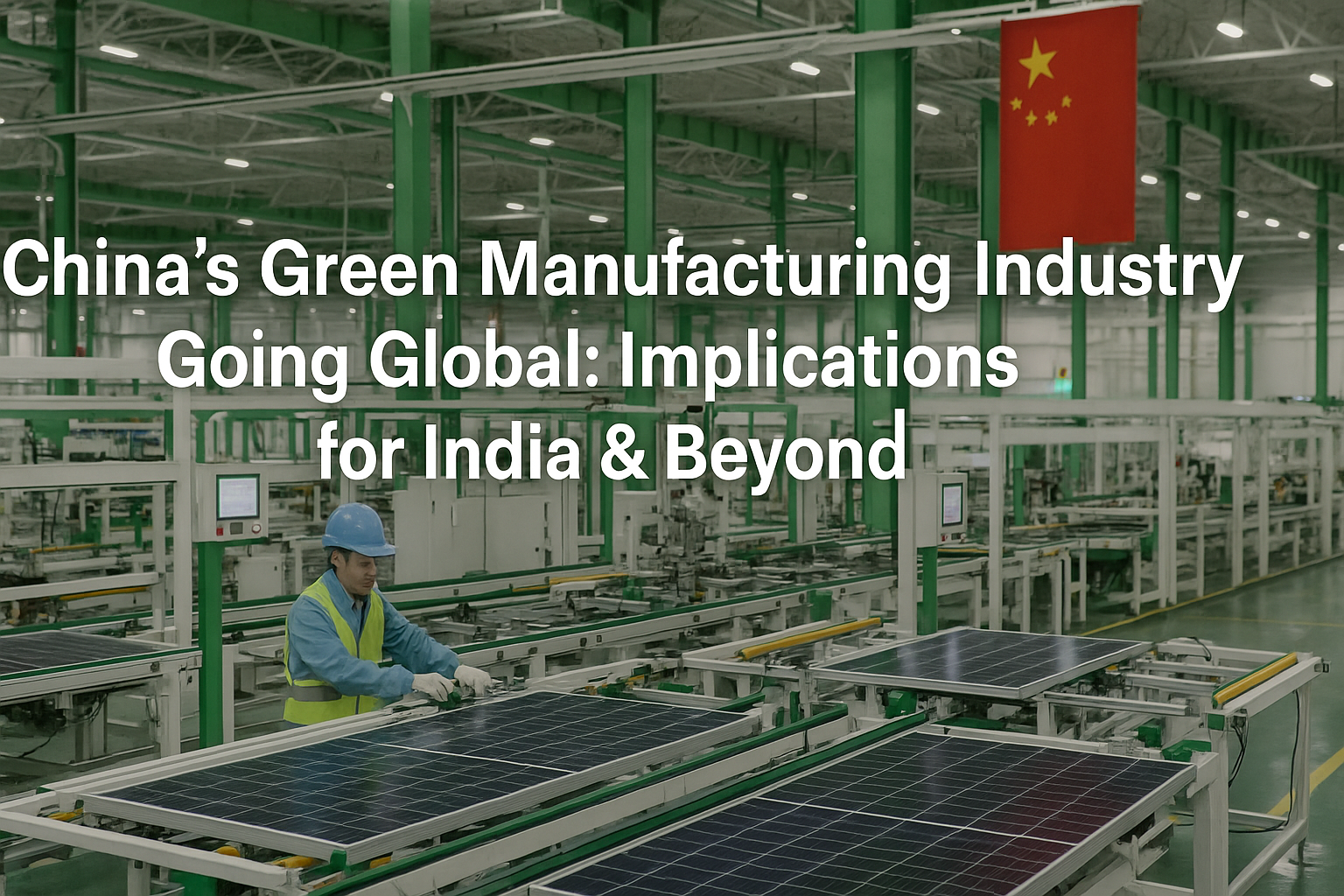
The global green-technology manufacturing landscape is undergoing a profound shift. According to a recent report by Energy Tracker Asia, Chinese green-tech manufacturers have expanded overseas investment into 54 countries, signalling that the country’s manufacturing ambitions are not just domestic but global. For India, which is itself accelerating its renewable manufacturing roadmap, this development offers both strategic opportunities and competitive challenges.
In this article, we explore how China’s green manufacturing expansion is playing out, what is driving it, what regions are attracting the investments, and what India (and other emerging markets) can learn and respond to.
Policy & Strategic Drivers of China’s Green Manufacturing Push
Several underlying drivers explain China’s global green-manufacturing ramp-up:
-
China’s ambition to anchor itself in the full green-tech value chain—from raw materials to final manufacturing—has long been visible via initiatives such as Made in China 2025, which emphasises green and sustainable production.
-
As domestic growth moderates and competition intensifies, Chinese manufacturers are seeking overseas locations with cost advantages, regional access and favourable export logistics. The database report emphasises that these are three key motivations: access to host-country markets, access to third-country markets and access to raw materials.
-
Policy instruments: China has set targets requiring more industries to step up their use of green power, signalling that manufacturing sectors will increasingly rely on renewables, further aligning manufacturing growth with the energy transition.
-
Global supply chain strategy: By extending manufacturing overseas, Chinese firms build resilience, diversify risk (including trade/tariff risk) and enable closer access to growth markets.
Investment Flows, Key Regions & Technologies
The Energy Tracker Asia report reveals several notable investment patterns:
-
Chinese green-technology manufacturers have committed over USD 57 billion into 135 overseas solar manufacturing projects alone. ASEAN remains the main destination.
-
ASEAN countries (Indonesia, Vietnam, Malaysia, Thailand) have been top-receivers historically, due to their cost base, proximity to Chinese supply chains and re-export role.
-
However, the pattern is shifting: by 2024 the ASEAN share of project-counts dropped, with regions such as MENA (Middle East & North Africa) growing rapidly—MENA projects surged from near zero in 2021 to over 20% of total investments in 2024.
-
The investment spread covers multiple technologies: solar modules, EV manufacturing, wind-equipment manufacturing, battery systems. Other sources suggest Chinese firms have committed more than USD 210 billion to green-tech manufacturing since 2022 (across 461 projects in 53 countries)
-
The strategy is clearly global: Chinese green-tech manufacturing isn’t just domestic, it is increasingly embedded in overseas production hubs and export networks.
Implications for India & Key Learnings
For India, which is pushing hard on renewable manufacturing (solar modules, electrolyser/green hydrogen, batteries, EVs), the unfolding Chinese strategy offers important implications:
Opportunities:
-
India can partner with Chinese-backed supply-chains: Some Chinese firms may seek Indian locations either as manufacturing anchors or export hubs—especially given India’s market size and favourable policy push.
-
Learning curve: The speed, scale and integration achieved by Chinese firms offers lessons in how to build manufacturing clusters, integrate raw materials, and build export-oriented production.
-
Export-hub potential: India could position itself as a competing hub for green-tech exports, especially to neighbouring regions (South Asia, Africa) if it builds cost-competitiveness and favourable trade frameworks.
Challenges/Competitive Risks:
-
China’s scale advantage and entrenched supply‐chains may crowd out nascent players in India unless India finds differentiated niches or aggressively pursues incentives.
-
As Chinese firms revisit geographic diversification (e.g., MENA, Central Asia) India must accelerate its manufacturing-ecosystem build-out.
-
Raw‐material access, cost pressures, and supply-chain dependencies remain hurdles for Indian manufacturing; Chinese firms already have strong integration upstream and overseas.
-
Trade/tariff and origin rules: Chinese overseas manufacturing can circumvent some export restrictions, while Indian firms need to navigate global trade regimes carefully.
What India Should Emphasise:
-
Strengthen upstream raw‐materials processing and refine critical minerals, to reduce dependence on imports.
-
Create clusters with integrated ecosystems (modules, batteries, assembly) and link to export markets.
-
Strengthen FDI openness, trade agreements and export-oriented manufacturing incentives to attract global green-tech supply-chains.
-
Focus on differentiated manufacturing segments (e.g., advanced battery chemistries, next-gen electrolysers, specialist EV components) rather than solely competing on cost.
-
Monitor China’s overseas moves to pre-empt where manufacturing is relocating, and consider Indian states/regions as viable magnets for such investment.
Risks, Overcapacity and Strategic Concerns
It’s not all smooth sailing for China either. Some of the risks that Indian and global observers should note:
-
Overcapacity: Reports flag concerns that rapid build-out of green manufacturing may generate oversupply, price pressure and margin squeeze.
-
Circular trade and geopolitics: China’s overseas manufacturing expansion intersects with trade tensions, rules of origin and export-controls (for example from US/EU). The diversification into other regions reflects this.
-
Environmental and energy-footprint: While manufacturing green tech is positive, the manufacturing process is still energy and resource intensive—and in many cases powered by coal. This paradox may slow climate gains.
-
Strategic dependency: Countries hosting Chinese green-tech manufacturing may become dependent on Chinese supply-chains. India must weigh this balance carefully.
Future Outlook
Looking ahead:
-
China’s overseas green manufacturing drive is set to continue, though perhaps with a shift from pure volume expansion to consolidation. The Energy Tracker report notes a “cooling” in the overseas build-out in early 2025, suggesting consolidation rather than acceleration.
-
For India, the window is now: As global supply-chains evolve, Indian policy and manufacturing investment need to keep pace. The “green-manufacturing race” is increasingly global and location-sensitive.
-
Collaboration models may become more common: instead of pure competition, joint ventures, supply-chain partnerships and regional manufacturing hubs (e.g., India-Africa, India-Southeast Asia) could emerge.
Conclusion
China’s green-technology manufacturing expansion is not just a domestic story—its global tentacles are reshaping supply‐chains, regional manufacturing hubs and export flows. For India, this delivers a two-fold signal: on one hand, a competitive benchmark of scale and speed; on the other, a strategic invitation to carve out its place in the global green-manufacturing ecosystem.
As India accelerates its renewable manufacturing ambitions—from solar modules to batteries to electrolysers—the country must act with urgency, agility and strategic foresight. The era of green manufacturing is global, and the winners will be those who build manufacturing ecosystems that are integrated, export-oriented and future-proof.
 2
2
 3
3
 4
4
 5
5

Leave a Reply