


Automakers Pave Road Ahead for Fuel Cells
by Jennifer Gangi
July 6, 2026
The fuel cell industry owes a debt of gratitude to the long-standing foresight, commitment, and investment of the automotive industry. From introducing the first fuel cell electric vehicles (FCEV) in the 1960s to commercial FCEVs available today, leading global automotive original equipment manufacturers (OEMs) have led us down the road of innovation and show no signs of slowing down.
These OEMs have spent billions of dollars over the past decades on early, mid-, and late-stage research and development (R&D) that have gone toward continuously reducing fuel cell system size and cost, increasing durability and driving range, and improving on components, storage, supply chain, and even manufacturing processes. The real-world testing and deployments have resulted in next-generation fuel cell passenger cars and sport utility vehicles, medium- and heavy-duty trucks and buses, and material handling and other logistics equipment, expanding customer options for zero-emissions vehicles that don’t compromise on performance or productivity.
FCHEA’s automotive OEM members are still innovating and improving on the fuel cell systems, as well as the hydrogen storage and components used in their drivetrains and vehicle platforms.
BMW Group
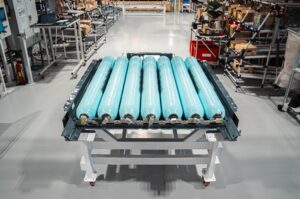
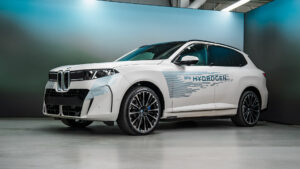
BMW introduced its Hydrogen Flat Storage system in April, an innovative hydrogen tank technology and configuration it has integrated in its new BMW iX5 Hydrogen passenger vehicle. The seven,1 kilogram (kg) high-pressure tanks are laid flat and connected together in parallel, along with several chambers to form an enclosed unit controlled by a central main valve rather than individual pressure vessels.
This fuel tank system increases the iX5 Hydrogen’s electric driving range to an estimated 750 kilometers (385 miles).
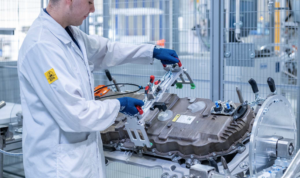
BMW has laid the foundation to meet the 2028 market launch goal and announced in May that its plant in Landshut, Germany, has started pre-series production of the “Energy Master,” a central control unit of its high-voltage system that will be installed on the Hydrogen Flat Storage system. This unit is the key interface between the fuel cell system, high-voltage battery, electric drive machines, and on-board electrical system, managing the power supply to ensure safe and intelligent operation.
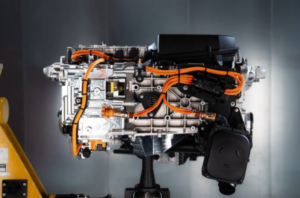
BMW is also working with fellow automaker and FCHEA member Toyota in developing advanced fuel cell systems for passenger and commercial vehicles, with the companies sharing core components of the fuel cell system while also developing brand-specific models. Through this partnership, BMW has made key improvements reducing size while increasing efficiency on its third-generation fuel cell system for passenger vehicles such as the iX5 Hydrogen. BMW’s fuel cell system takes up less space with higher power density and range and can be integrated into future vehicle architectures with different drivetrain options.
Toyota Motor Corporation
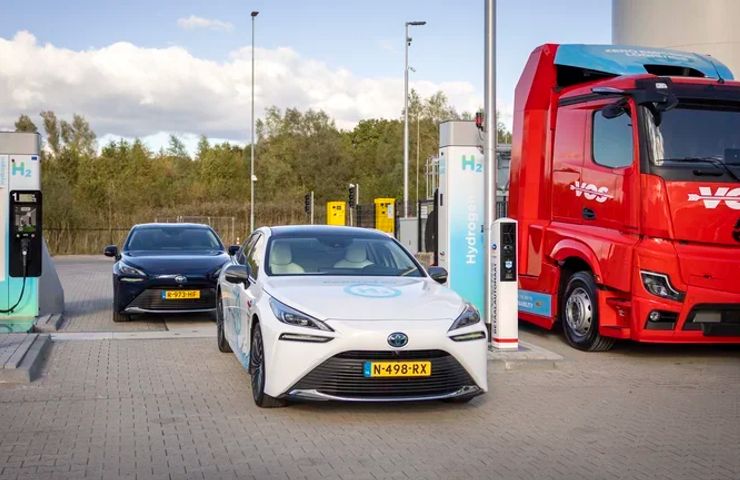
In recent months, Toyota has also made advancements expanding on its experience with its Mirai fuel cell passenger car to utilize the fuel cell system in other markets such as stationary power generation, commercial trucking, and more. Toyota’s fuel cell was recently certified by both the American National Standards Institute (ANSI) and CSA Group, under the groups’ ANSI/CSA FC 1 and ANSI/CSA FC 6 standards, which cover stationary fuel cell power systems intended for indoor and outdoor commercial, industrial and residential use in non-hazardous (unclassified) areas.
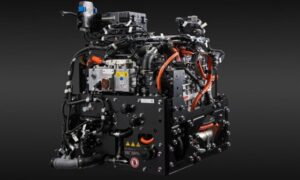
On the mobility side, Toyota is teaming up with other companies to share expertise and technologies to develop new fuel cell vehicles. This includes working with Isuzu to integrate its fuel cell system into Isuzu’s ELF EV BEV light-duty truck platform and signing a non-binding agreement with Daimler Truck and Volvo to become the third joint venture partner in cellcentric to develop fuel cell systems for heavy-duty vehicles.
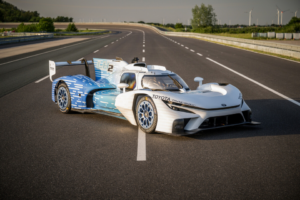
Off the road and onto the track, Toyota announced two debuts of hydrogen-fueled racing cars that would be taking laps in Japan and France. The TGRR GR Corolla H2 concept at the ENEOS Super Taikyu Series 2026 Empowered by BRIDGESTONE Round 3 NAPAC Fuji 24 Hours Race in Japan; and the TR LH2 Racing Prototype at Le Mans 24 Hours in France. Both vehicles use liquid hydrogen and showcase innovative solutions for sustainable racing.

Other off-road applications include logistic vehicles at ports and airports, among other sites. Toyota Nederland signed an agreement with the Rotterdam Hague Innovation Airport (RHIA) to support the integration of hydrogen-powered ground service equipment that will operate at the airport.

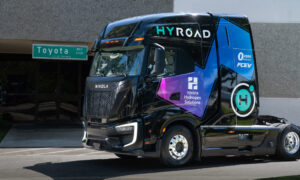
In the U.S., Toyota Motor North America is planning on deploying 40 hydrogen fuel cell Class 8 commercial trucks from Hyroad Energy to support its logistics operations in Southern California. Toyota’s North American Parts Center California will serve as the vehicles’ base of operations, with fuel provided by Air Liquide.
Hyundai Motor Group
With a multi-billion-dollar investment in its Ellabelle manufacturing plant and the deployment of 21 of its XCIENT Fuel Cell trucks for logistical support there, Hyundai is firmly planting its roots in Georgia. Building on that, Hyundai has forged a real partnership with the Georgia Institute of Technology (Georgia Tech) to advance hydrogen-powered transportation, deepen applied research and education, and accelerate zero-emissions vehicle deployment in the state. Hyundai has donated four of its NEXO fuel cell electric SUVs to the school and a hydrogen electrolyzer project, which will be installed at Georgia Tech’s North Avenue Research Area (NARA) to support campus operations and offer hands-on interdisciplinary research.
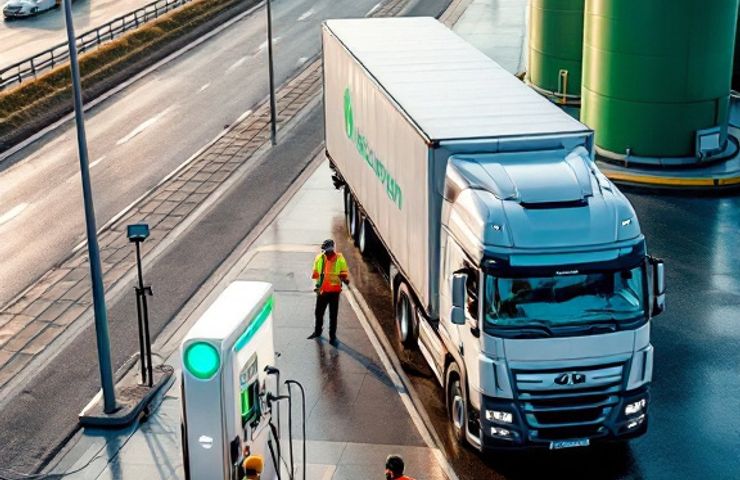
Hyundai also continues to expand its fleet of XCIENT trucks around the world. There are 11 currently operating in Canada in several hydrogen mobility initiatives, and the automaker recently announced that Breadner Trailers, an established Hyundai Translead trailer dealer, will expand its role to serve as a dealer for the XCIENT Fuel Cell trucks in Canada.
Ensuring a complete hydrogen ecosystem to support its fuel cell trucks, Hyundai is making big investments in infrastructure and value chain. The company’s HTWO brand is focused on not just producing hydrogen to fuel vehicles, but also storage and distribution.
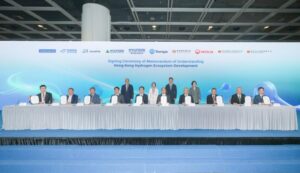
In Hong Kong, Hyundai is now working with companies from Korea, China, France, and Hong Kong, to develop low-carbon waste-to-hydrogen (W2H) production facilities utilizing landfill gas (LFG) as feedstock. The companies are also building an initial hydrogen refueling infrastructure, to store and distribute that hydrogen for fuel cell buses and airport vehicles. The companies have set a target date to select a project site and design the facility starting next year, with the goal of being fully operational by the end of 2030.
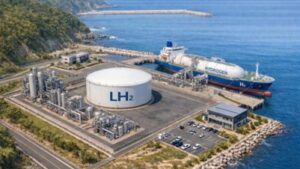
Hyundai’s Engineering and Construction (E&C) group in Korea was selected for a national R&D project, “Development of Liquid Hydrogen Storage Tanks and Loading/Unloading System Technologies,” develop large-scale liquid hydrogen storage tanks.
29 billion won ($19.5 million) was awarded by the Korea Agency for Infrastructure Technology Advancement (KAIA) under the Ministry of Land, Infrastructure and Transport (MOLIT) for the three-year project, with the goal of demonstrating the storage, transfer, and handling of liquid hydrogen at receiving terminals, to analyze the full lifecycle and necessary infrastructure.
This committed investment by the automotive OEMs, the countries they operate in, and their partners and customers that continue to demand more zero-emission options to meet decarbonization and energy security goals, is incredibly important to the entire fuel cell and hydrogen industry. With each advancement and technology improvement on not just the fuel cell systems, but the infrastructure necessary to keep them running, we all move further down the road to a global hydrogen economy.
For previous Catalyst blog updates for other ‘on-road’ applications, see our previous reporting on fuel cell bus and truck orders and deployments.
The post Automakers Pave Road Ahead for Fuel Cells appeared first on FCHEA.
What's Your Reaction?
 Like
0
Like
0
 Dislike
0
Dislike
0
 Love
0
Love
0
 Funny
0
Funny
0
 Wow
0
Wow
0
 Sad
0
Sad
0
 Angry
0
Angry
0





Comments (0)