


An energy system for climate goals
Energy economists may wince when they first read the study “Cost-Optimal Transformation of the German Energy System by 2045,” prepared by Fraunhofer ISE for The smarter E Europe exhibition. The study, which formed the scientific foundation for the Renewables 24/7 special exhibit at The smarter E Europe, forecasts approximately 120 TWh of electricity generation from gas-fired power plants in 2045 – powered by climate-neutral hydrogen, biomethane, or synthetic gas.
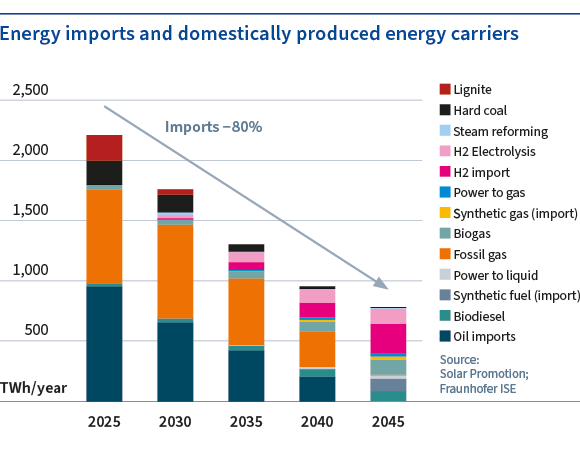
The installed capacity of these power plants is estimated at 146 GW, corresponding to roughly 822 full-load hours. Mathematically, this would mean roughly 10 hours of downtime for every hour in operation. Even for a generation method where a very high proportion of the levelized cost of electricity is attributable to fuel, this is a significant imbalance. From an operator’s perspective, such a system is likely only feasible in a capacity market.
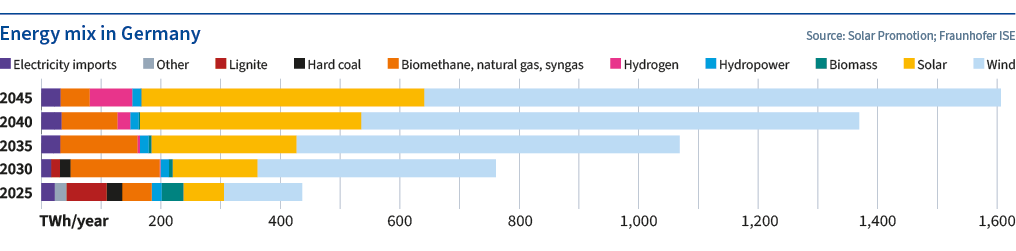
For Germany in particular, this topic has been the subject of heated debate for some time, even though the current capacity tenders issued by the German government only involve 11 GW. The study’s scenario goes several steps further, envisioning gas power plants as backup in a virtually emissions-free energy system. They would cover only 7% of Germany’s electricity generation, which, due to widespread electrification, is modeled at 1,066 TWh in 2045, almost four times the 2025 figure of 443 TWh.
The study shows one possibility for a working 24/7 renewable energy system in Germany, and its authors note that it should not be mistaken for a forecast. “We wouldn’t say that we’re making a prediction with our model, but rather we’re showing, in a normative way, what a system that achieves climate protection goals could look like,” explained ISE senior scientist Charlotte Senkpiel, who created the study alongside her colleague Christoph Kost and a team of ISE experts in various disciplines. The likelihood of such a system being built, along with other practicalities such as regulating entirely via capacity markets and reducing gas-fired capacity if it were also used to charge large battery energy storage systems, are not addressed in the 40-page study.
The model, titled REMod, is defined by ISE as a “national energy system model with a focus on cross-sectoral system development.” It operates on real weather data – the latest study uses data from 2011-15 at hourly resolution. All generators, storage systems, converters, and consumers are dimensioned so that the energy balance of the overall system is met at every hour, allowing for the modeling of various charging strategies for electric vehicles, or the interaction of thermal storage systems with different heating systems “at any desired level of detail,” the study explains.
The model was developed by Hans-Martin Henning, who until his retirement in 2025 co-directed Fraunhofer ISE with Andreas Bett. The first study based on REMod, “100% Renewable Energy for Electricity and Heat in Germany,” was published in 2012. Since then, the model has been continuously developed.
Big picture
In that time, Senkpiel said that the big picture hasn’t changed much. “We’ve always said that electrification will play the dominant role in the future energy system, and that makes sense because it’s simply the most efficient way.” The latest study devotes considerable attention to the question of around-the-clock reliability in connection with a 100% renewable energy system. It presents seven weeks in 2045 as examples (using weather data from 2015), including two weeks in January and October with low wind and solar generation.
The most important flexibility options are storing surplus electricity in batteries or as hydrogen, using climate-neutral gases and the European grid interconnection. The flexible operation of power-to-gas plants and heat pumps in conjunction with thermal storage systems is also significant.
Although the experts at Fraunhofer ISE take a more conservative approach compared to similar studies, their scenarios still yield some unexpected results. Even during periods of low wind and solar output, there are short phases of surplus electricity that can be stored in batteries and used for power-to-X processes. Conversely, a typical January week, despite very low solar power production, has substantial electricity surpluses that must be curtailed if they cannot be exported. The impact of having 308 GW of wind power connected to the grid is clearly noticeable.
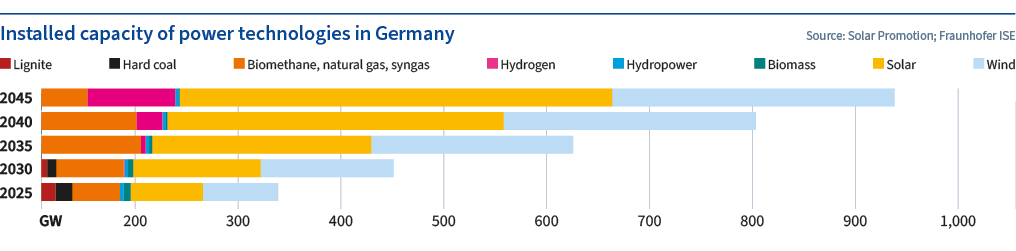
This impact becomes yet more noticeable when renewables make up around 90% of the installed capacity, with 30% wind and 60% solar. This is shown most clearly by the calculated need for material energy sources. In 2025 it amounted to 2,211 TWh – oil, gas and coal, as well as tiny amounts of biogas and biodiesel, 67% of which have to be imported.
This amount would fall by 65% to 779 TWh by 2045, and at this scale could be largely produced within Germany because, in addition to biogas and diesel, it primarily relies on synthetically produced fuels and hydrogen. This would reduce import dependency by 80%. In times when politicians hardly formulate a sentence without the word “resilience,” this is a powerful argument, as is the expected economic stimulus through investments, additional gross value creation, and jobs. However, according to the study, the additional costs for the renewable energy system compared to continuing the fossil-fuel status quo are on average €54 billion ($62.6 billion) per year.
That’s a lot of money, but not as much as the relief measures during the 2022-23 energy price crisis cost. The study mentions at least €71 billion, and €187 billion if general income relief is included.
German economic research institute IW estimates almost €240 billion for all three relief packages in the 2022-24 period. Be that as it may, if you take any reasonable estimate of the consequential costs of climate change as a comparison, discussion becomes unnecessary. Or, as it says in the “overall assessment” section of the study: “The central challenges lie not in the area of technical or economic feasibility, but in the actual speed of implementation of the necessary measures.”
The post An energy system for climate goals appeared first on pv magazine Global.
What's Your Reaction?
 Like
0
Like
0
 Dislike
0
Dislike
0
 Love
0
Love
0
 Funny
0
Funny
0
 Wow
0
Wow
0
 Sad
0
Sad
0
 Angry
0
Angry
0







Comments (0)