

Can Beijing end the race to the bottom?
China’s solar industry has spent two decades proving how far costs can fall. It is now confronting a harder question: how low is too low?
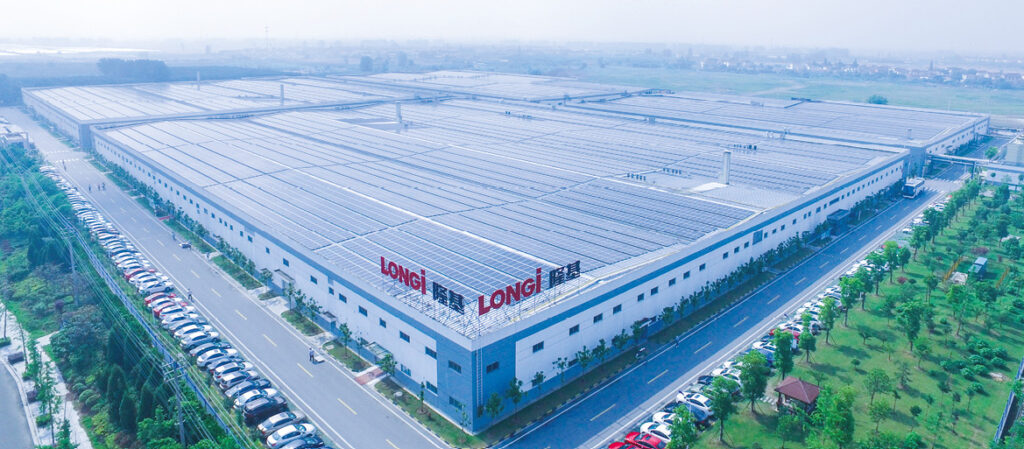
The need for an answer has become urgent. In the first half of 2026, some of China’s largest solar manufacturers remained deeply in the red despite technological gains and enormous shipment volumes. Tongwei posted a net loss of CNY 5.12 billion ($763 million), Longi CNY 3.68 billion, TCL Zhonghuan CNY 3.20 billion, JinkoSolar CNY 3.08 billion and JA Solar CNY 2.66 billion. Together, the five companies lost more than CNY 17 billion in six months.
The industry has been exceptionally good at adding capacity, but far less effective at removing it. Persistent oversupply has pushed prices below levels that support normal returns, while companies have kept factories running to preserve cash flow, employment and market share.
“Production capacity across all segments of the PV supply chain has exceeded demand projections for 2035. Capacity clearance remains the industry’s greatest challenge,” noted BloombergNEF PV analyst Tan Youru.
Beijing has stepped up its response. What began as appeals for industry self-discipline has evolved into a broader “anti-involution” campaign – which has become a common Chinese policy term for curbing excessive, self-defeating competition, especially repeated capacity expansion and price-cutting that destroy returns across an entire industry.
In solar, that campaign now combines price regulation, standardized cost accounting, mandatory efficiency and energy-consumption rules, tax changes and pressure for capacity rationalization. The objective is not simply to lift module or polysilicon component prices, but rather to terminate the incentives that allowed destructive competition to persist.
Hard constraints
China’s latest solar downturn is unusual because losses alone have failed to clear the market.
Solar manufacturing is capital intensive. Once a factory is built, a producer may keep operating at poor margins as long as sales contribute toward fixed costs. Large manufacturers are reluctant to cut first if it means competitors would gain market share. Local governments, lenders and suppliers also have motivations to keep plants alive because closures affect employment, tax revenue and debt repayment.
Technology transitions further complicate this scenario. Older capacity does not disappear when a new generation of equipment is installed. It is preferred to remain in the market at lower prices to maximize its value, while its owner invests in newer lines to avoid falling behind.
This results in a prolonged adjustment rather than a clean correction. Since the fourth quarter of 2024, China’s PV industry has endured a sustained price decline lasting more than 20 months, with corporate operating profits collapsing in tandem. That’s why policy is shifting to include enforceable constraints.
Standardized accounting
One potentially decisive change came in July, when the China Photovoltaic Industry Association (CPIA) released a standardized cost-accounting model covering the main links of the PV manufacturing chain. What does selling “below cost” mean? For years, the industry has lacked an answer. A manufacturer can cite cash cost, manufacturing cost or full cost. Integrated producers can allocate costs differently from specialized producers. Depreciation, financing expenses and related-party transactions can materially alter the result.
“Cost advantage has always been one of China’s core competitive strengths in solar,” said CPIA Executive Secretary-General Liu Yiyang. “But if prices remain detached from companies’ true costs for too long, reasonable investment and sustainable operations cannot be guaranteed.”
The cost model combines voluntary reporting and sample audits, according to CPIA. Member companies submit monthly production-cost data for each manufacturing segment, which are aggregated and anonymized to calibrate the model. Since the second quarter of 2026, Deloitte and EY have conducted sample checks on participating companies, examining raw-material procurement prices, depreciation policies, related-party transactions and whether losses are being shifted outside the reporting entity.
Audit results are graded and unreliable data are removed from the model’s sample pool. CPIA also uses cross-checks to validate submissions.
Yan Dazhou, director of the National Engineering Research Center for Silicon-Based Materials Preparation, said the standard ends a situation in which “everyone defines costs differently” and provides a practical benchmark for enforcing rules against below-cost bidding. That framework was tested almost immediately.
On Aug. 6, eight major polysilicon producers, accounting for more than 90% of China’s effective polysilicon capacity, signed an anti-involution pledge committing to keeping sales prices, including tender bids, at or above the corresponding full cost calculated in the CPIA model.
At the end of July, average dense polysilicon prices were around CNY 31.5/kg. Industry estimates put full cost broadly at CNY 40/kg to 50/kg.
Prices then moved sharply higher. InfoLink’s Sept. 9 assessment put mono-grade polysilicon at CNY 38/kg to 43/kg, averaging CNY 40/kg. Two days later, commodities data provider Mysteel estimated n-type polysilicon at CNY 40.5/kg, against production cost of CNY 42.3/kg and full cost of CNY 45.6/kg. The gap has narrowed, but average prices remain below estimated full cost.
Nor has the underlying imbalance disappeared. InfoLink said actual transactions remained scattered, with large downstream buyers reluctant to accept higher prices, while September polysilicon output was expected to rise and inventories continued to build.
So far, anti-involution has changed price expectations faster than supply-demand fundamentals.
Survival thresholds
Price discipline is only one part of the reset. China has issued three mandatory national standards covering energy consumption in polysilicon and monocrystalline silicon production and efficiency requirements for crystalline-silicon modules and inverters. All three take effect on Jan. 1, 2027.
Existing polysilicon plants using the dominant trichlorosilane process must keep comprehensive energy consumption at or below 6.3 kg of standard coal equivalent per kilogram of polysilicon. For modules, the minimum Grade 3 conversion-efficiency threshold is 23.2% for tunnel oxide passivated contact (TOPCon) and heterojunction (HJT) products and 23.5% for back-contact (BC). These are legal thresholds. Plants or products that cannot comply must be upgraded or removed from the market.
The potential impact of the new thresholds is substantial. The Silicon Industry Branch of the China Nonferrous Metals Industry Association estimates that China’s effective polysilicon capacity will fall to around 2.4 million metric tons (MT) annually after restructuring. That would be 16.4% below the level at the end of 2024 and 31.4% below roughly 3.5 million MT of installed facilities – implying about 1.1 million MT of nameplate capacity being cleared.
Some market analysts expect an even larger impact downstream. CITIC Securities said in an Aug. 22 report that the efficiency thresholds could cut around 45% of outdated cell capacity, reducing n-type cell capacity from 1 TW to about 600 GW.
Huatai Securities estimates that up to 327.6 GW of module capacity, or 33% of the total, could be eliminated. Even under its most conservative scenario, in which every manufacturer upgrades existing lines to the best technically achievable level, it still sees 153.6 GW, or about 15%, permanently leaving the market.
But the headline figures overstate the likely short-term impact if they count capacity that is already offline.
CITIC Futures Research argues that much of the polysilicon capacity failing the new standards is already idle “zombie capacity” – unprofitable, debt-ridden manufacturing output. Removing this may slash nominal capacity statistics while barely changing actual supply.
Significant shift
There are signs of real change. Executives at several polysilicon producers told pv magazine that roughly 1.1 million MT of nameplate capacity across second- and third-tier companies is currently shut and has no restart plan. Qinghai Lihao has permanently closed 80,000 MT of older, high-energy-consumption capacity. Asia Silicon’s production lines are largely shut, while capacity at producers including Qiya Group, Ginno, Goens, CSG, Dun’an, Hongyuan Green Energy, Huamin and smaller producers in Yunnan, Hubei and Gansu is broadly idle, according to executives interviewed.
Still, idled is not the same as permanently removed. Much of that capacity has not been physically dismantled and could be returned if economics improve. But doing so would require its owners to bear substantial restart costs.
Downstream companies are showing restraint by canceling expansion before it is built.
Aiko has terminated a planned 15 GW TOPCon cell project and is instead converting existing capacity toward its all back-contact (ABC) technology. Trinasolar has abandoned the 15 GW second phase of a planned 35 GW monocrystalline ingot project after completing the first 20 GW.
Industry executives told pv magazine that Longi, JinkoSolar and JA Solar have also largely frozen capacity-related capital expenditure.
A senior executive at one leading manufacturer said Jan. 1, 2027, will be the decisive test. Once the mandatory standards take effect, operating lines that fail Grade 3 requirements will face a legal choice between upgrading or closing. Permanent exit, the executive said, will then move from canceling planned projects to retiring or dismantling existing operating capacity.
That is the real test, as higher prices alone do not equal restructuring. If prices recover and idled factories simply restart, or companies launch another expansion cycle, anti-involution will have only postponed the problem rather than solved it.
The indicators that matter are capacity utilization, inventories, permanent closures, mergers and acquisitions, operating cash flow, gross margins, capital expenditure and new capacity announcements.
“The sustained push against ‘involutionary’ competition will drive profound changes in the industry’s competitive landscape,” said Wang Jian, an analyst at TrendForce Consulting. He said he expects market share to concentrate among companies with stronger technology, cash flow and global reach, while manufacturers dependent on simple capacity expansion and lacking technological upgrade capabilities will exit faster.
In that sense, anti-involution is already becoming a consolidation policy, even if it is not formally described as such.
Future stability
For global buyers, a successful reset would probably mean a firmer floor under Chinese module prices. That may marginally raise procurement costs, but it could also reduce the risks of financially weak suppliers, aggressive cost cutting and long-term warranty exposure.
China is changing what its manufacturers are rewarded for. Scale, cost and market share remain important, but efficiency, energy use, product quality, financial resilience and technological differentiation are gaining weight. Fiscal policy reinforces that change. VAT export rebates have been removed, while conventional solar cells will face a 2% consumption tax from April 2027, rising to 4% a year later. Perovskite, tandem and gallium-arsenide cells remain exempt through 2028.
The direction is clear. Policy is becoming less supportive of simply producing more mature products, and more selective about technology and efficiency.
But the reset will only succeed if capacity actually leaves the market.
China has proved it can make solar extraordinarily cheap. The next test is whether it can make the industry financially sustainable without surrendering the cost and technology advantages that made it dominant.
The post Can Beijing end the race to the bottom? appeared first on pv magazine Global.
What's Your Reaction?
 Like
0
Like
0
 Dislike
0
Dislike
0
 Love
0
Love
0
 Funny
0
Funny
0
 Wow
0
Wow
0
 Sad
0
Sad
0
 Angry
0
Angry
0




Comments (0)