


Concentrated solar heat and hydrogen to decarbonize iron ore processing
Steel production accounts for roughly 7% of global greenhouse gas emissions, and nearly 70% of that comes from coal-fired blast furnaces; the dominant way the world has made iron for centuries.
The Electric Arc Furnace (EAF) could decarbonize steelmaking because it can be powered by renewable electricity. It requires very pure sponge iron.
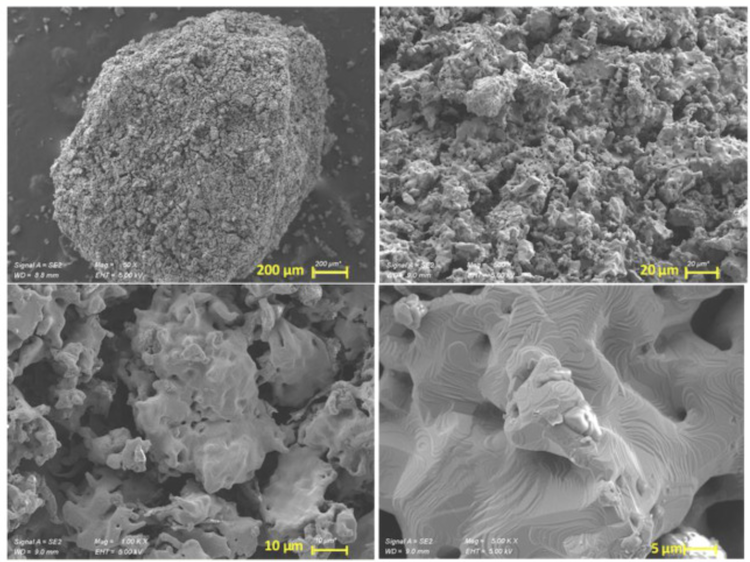
Porous sponge iron is very pure metallic iron with voids where oxygen and impurities have been extracted, so it melts easily and makes stronger steel.
Now, for the first time, a French research team has demonstrated producing this pure sponge iron with no carbon emissions. The iron ore can be directly reduced using hydrogen as the reductant and concentrated solar energy as the heat source.
Their paper Complete solar thermal direct reduction of iron ore by hydrogen in a particle-fed reactor under concentrated sunlight, was published in June 2026 in Resources Chemicals and Materials.
The team showed that particle conversion approaching 99% is achievable in a solar rotary kiln reactor, developed in a French ANR funded project.
“The goal is to replace the combustion of coal, and its use as a reducer, with a process with no carbon at all,” said lead researcher Stéphane Abanades of the French National Center for Scientific Research (PROMES-CNRS).
“That’s why we use the hydrogen for iron oxide reduction instead of coal, to reduce carbon emissions — so we produce only water, and the source of energy in our case is concentrated solar energy.”
The industrial direction for decarbonizing the direct reduction of iron (DRI) process has largely focused on using renewable electricity to heat a furnace fed with hydrogen instead of coal. But electricity, even green, adds a step. Using heat directly to supply the reaction enthalpy is more efficient than converting electricity to heat. Converting electricity to thermal energy involves losses. A concentrating solar thermal system can deliver the high-temperature process heat directly.
“So we propose to use concentrated solar thermal for the heat supply at over 800-1000°C,” he explained.
“This solar process doesn’t exist currently. We don’t have any example of a currently existing process for this reaction. That’s why we need to develop an optimal reactor and find the optimal conditions to run the reaction. In this DRI reaction, we have to inject the ore particles to react with a gaseous reducer and then extract the iron product continuously, so it is quite different from existing solar reactors. There is currently no reliable, scalable, and mature solar reactor technology adapted to this pyrometallurgical process. This study aims to fill that gap.”
A reactor purpose-built from scratch
The team at PROMES-CNRS built a custom rotary kiln solar reactor — a sealed, conical ceramic cavity that sits at the focal point of a parabolic concentrator delivering up to 16 MW/m² of peak solar flux. The iron ore particles are fed continuously from the back of the rotating cavity through a screw feeder, tumble through the hot zone under a flow of hydrogen gas, and fall out the front into a collection tank as reduced iron.
The entire cavity is enclosed behind a glass window to keep air out, since the reaction requires a pure hydrogen atmosphere. Unlike their earlier solar thermochemistry work using carbonaceous feedstocks such as methane or biomass, where carbon deposits may gradually obscure sunlight on the window, this one remains clear.
“We just have hydrogen as a reducer, so we don’t produce any byproduct — we produce only steam. This is the only gaseous product that we produce, so there is no deposition on the window. The window remains clean for this reaction,” Abanades said.
The chemistry is:
Iron ore (mainly hematite, Fe₂O₃) is reduced to metallic iron through three sequential steps above 570 °C:
Fe2O3→Fe3O4→FeO→Fe
With hydrogen as reductant, the overall reaction is:
Fe2O3+3H2→2Fe+3H2O ΔH°=+97.5 kJ/mol
Iron oxide is reduced (gains electrons, loses oxygen)
Hydrogen is oxidized (H₂ → H₂O)
The stickiness problem and the solution
The research team’s first challenge was purely mechanical: getting the iron ore particles to flow smoothly through the hot reactor without gluing themselves to the walls. At temperatures above 800–1000°C, freshly formed iron particles tend to agglomerate and stick to surfaces.
They first tested a stainless steel cavity, then a ceramic cavity made of mullite (a mixture of alumina and silica). Both had problems. “With the mullite, it was not the best option when we tested,” Abanades said. “It allowed good heating of the cavity because the mullite is resistant to high temperatures, but the flow of particles was not the best.”
The solution was boron nitride (BN), a material commonly used in molten metal processing precisely because metals don’t stick to it.
“The particle flowability was greatly improved with this material,” Abanades said. “We can operate really continuously, and we have very minimal particle retention in the cavity, and we can extract the particles continuously.”
Getting the residence time right
Even with the particle flow problem solved, the team hit a second challenge: in a small lab-scale reactor with a cavity just 10 centimeters long, the particles didn’t spend enough time in the hot zone to fully convert to iron before falling out the front.
Their solution was an elegantly simple operating tweak: stop rotating the cavity while the particles are reacting, letting them sit in the high-temperature zone until the hydrogen consumption signal showed the reaction was complete. Then switch the rotation back on to discharge the product.
“But this is just due to the small scale of the lab-scale reactor,” Abanades explained. “We are at 1.5 kilowatts of incoming power, we have a small solar concentrator, and so the cavity cannot be very large to allow reaching the required temperature for the reaction. The cavity in our case was 10 centimeters long and 6 centimeters diameter. If we continuously rotate the cavity, the particles don’t have enough time to react even at the minimum rotation speed.”
This is not a fundamental limitation of the process, but just a geometry problem due to the initial lab bench scale.
“When we upscale the reactor — in our case, it is 10 centimeters; if we use 100 centimeters— then the residence time of particles will be increased by a factor of 10 also. The length will be 10 times, and so we have no problem to increase the particle residence time in continuous mode if we keep the same rotation speed. The conversion will be directly improved by this point.”
The post Concentrated solar heat and hydrogen to decarbonize iron ore processing appeared first on SolarPACES.
What's Your Reaction?
 Like
0
Like
0
 Dislike
0
Dislike
0
 Love
0
Love
0
 Funny
0
Funny
0
 Wow
0
Wow
0
 Sad
0
Sad
0
 Angry
0
Angry
0








Comments (0)