

Green hydrogen’s growing share in chemical production
It’s often said that if a major industrialized economy like Germany’s could achieve 24/7 renewable energy supply, so can anywhere else. There’s hardly a better place to understand where this idea comes from than at BASF’s headquarters and the world’s largest contiguous chemical production site in Ludwigshafen. A facility like this, with around 33,000 employees and stretching over five kilometers along the banks of the Rhine River in western Germany, requires enormous amounts of energy and equally enormous amounts of hydrogen. The element is needed to produce basic chemicals such as ammonia and methanol, is a component of many polymers, and is also used in the production of vitamins.
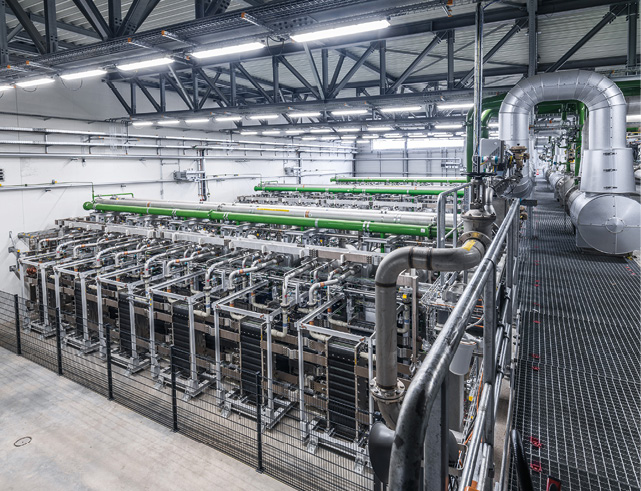
This makes Ludwigshafen the ideal location for Germany’s largest proton-exchange-membrane (PEM) electrolyzer. In a collaboration between BASF and Siemens Energy, the plant went into operation in March 2025 after about two years of construction. The partners said that the electrolyzer is “unique worldwide in its integration into a chemical production environment.” Hopefully, this will not remain the case for long, as the chemical industry currently generates the bulk of its hydrogen needs using natural gas. Some hydrogen is also produced as a byproduct in certain production processes.
The scale of the challenge involved in transitioning to climate-neutral H2 production can be illustrated by the dimensions of the Ludwigshafen PEM electrolyzer. The project, named H4Chem, received approximately €124 million ($143.8 million) in funding from the German federal government and the state of Rhineland-Palatinate, while BASF itself invested €35 million. Siemens Energy interconnected 72 stacks in three so-called arrays in the electrolyzer, which has a power capacity of 54 MW.
The production capacity is sufficient for approximately 1 metric ton (MT) of hydrogen per hour. At full capacity, the operators estimate an annual output of 8,000 MT. That is an enormous amount, though not when compared to the total annual hydrogen production capacity in Ludwigshafen, which BASF states is “up to about 200,000 MT.” The company does not disclose exact figures for competitive reasons, nor does it publish the ratio between the hydrogen produced as a byproduct of other processes and the amount generated specifically for this purpose. What is clear, however, is that to fully supply the Ludwigshafen site with hydrogen via PEM electrolysis, it would need to add another one to two dozen plants of the current size.
It is clear, however, that steam reforming must relinquish its previously dominant role in hydrogen production, as this relies almost exclusively on methane (i.e., natural gas; biomethane is currently still a largely theoretical option). In addition to PEM electrolysis, BASF is exploring other processes in this area. At the Schwarzheide Industrial Park in eastern Germany, operated by BASF InfraService & Solutions Lausitz, Dresden-based company Sunfire is constructing a high-temperature electrolyzer. With a nominal power consumption of around 1.3 MW and a production rate of 36.5 kg per hour, it is significantly smaller than the PEM electrolyzer in Ludwigshafen. Sunfire cites electrolyzer efficiency of up to 89.9% as the technology’s greatest advantage, compared with the 60% to 70% typically associated with PEM systems. However, the definition of efficiency for such plants is somewhat complex, and other parameters are also relevant to economic viability.
Demand response
Flexibility is particularly important, so the PEM electrolyzer integrated into the grid at the Ludwigshafen site must be able to respond to current hydrogen demand, quantities generated elsewhere in production facilities, minimum loads, and similar parameters, as well as to the availability and current price of its feedstock – renewably generated electricity. In the context of 24/7 renewables, the latter is both a challenge and an opportunity, since an electrolyzer also offers enormous flexibility that can be put to excellent use in stabilizing an electricity system based entirely on renewables.
A third process – which BASF says it has been working on for over 10 years and has also validated at a test facility in Ludwigshafen – is methane pyrolysis. Together with the energy company Exxon Mobil, BASF now plans to build a large-scale demonstration plant in the United States. Compared to PEM electrolysis, the process requires only about one-fifth of the electrical energy – a huge advantage from a business perspective. But even when using green electricity, the hydrogen produced isn’t truly green. It’s turquoise, meaning that the demonstration plant planned by BASF and Exxon Mobil in the United States will produce 2,000 MT of hydrogen and 6,000 MT of carbon annually. The carbon created in this process does not enter the atmosphere, but is collected in solid form.
The PEM electrolyzer in Ludwigshafen is a flagship project in the truest sense of the word. Not only because of its size – Siemens Energy has long been planning a plant for the Hamburg Green Hydrogen Hub that, at 100 MW, is nearly twice as large – but also because of the significance of such projects for competition among the various production technologies. This competition is necessary because building future hydrogen infrastructure, in whatever form it ultimately takes, requires a variety of industrially proven solutions.
The post Green hydrogen’s growing share in chemical production appeared first on pv magazine Global.
What's Your Reaction?
 Like
0
Like
0
 Dislike
0
Dislike
0
 Love
0
Love
0
 Funny
0
Funny
0
 Wow
0
Wow
0
 Sad
0
Sad
0
 Angry
0
Angry
0







Comments (0)