


Heterojunction’s long road to the US solar factory
Canadian Solar provides the most visible example of a manufacturer with a US presence committing to HJT technology. In July 2026, its CS PowerTech subsidiary officially opened the first phase of a new HJT cell factory in Jeffersonville, Indiana. The initial 2.1 GW phase forms part of a site intended to reach 6.3 GW of annual cell capacity at full build-out, following an investment approaching $1 billion.
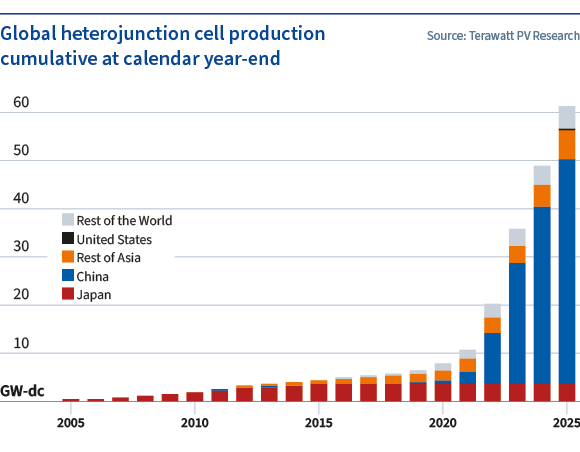
For the US solar industry, the significance extends beyond another few gigawatts of domestic cell capacity, because HJT itself has a commercial history stretching back to Sanyo in Japan, long before passivated emitter and rear cell (PERC), tunnel oxide passivated contact (TOPCon), and many of the technologies that subsequently defined successive generations of crystalline silicon (c-Si) manufacturing. During that time, HJT has repeatedly demonstrated some of the attributes the industry values most, including high conversion efficiency, excellent surface passivation, strong bifacial performance and an attractive temperature coefficient.
While HJT has not yet been a mainstream technology choice, its checkered commercial history should not be taken as evidence of shortcomings in the underlying cell architecture. On several occasions, companies have invested heavily in the technology, achieved competitive cell and module performance, and demonstrated that HJT can be manufactured at industrial scale. Yet each attempted expansion has taken place against a moving backdrop in which more conventional approaches to c-Si production have advanced at a rapid pace.
Consequently, the latest US investment cycle raises an interesting question over whether the circumstances surrounding HJT have now changed sufficiently for a technology that solar manufacturing has considered many times before, but never fully embraced, to establish a more durable position.
Sanyo inheritance
Although HJT is often discussed today alongside newer cell technologies such as TOPCon, its origins belong to a much earlier phase of the solar industry. While the basic concept of forming a junction between amorphous and crystalline silicon dates back to the 1970s, it was Japan’s Sanyo Electric that developed the architecture into the form recognizable in modern HJT production during the early 1990s, with this work taking place within a much broader Japanese effort to establish solar PV as a commercially viable technology.
In essence, Sanyo developed and commercialized HJT at a time when the high-volume n-type wafer supply chain familiar to manufacturers today had yet to emerge. That distinction would become increasingly important as other companies began trying to manufacture HJT outside the Sanyo system.
Even while Sanyo, and later Panasonic, remained the principal commercial manufacturers of HJT cells and modules, interest in reproducing the technology outside Japan was increasing. By the end of the 2000s, research institutes and equipment suppliers in Europe and Asia were developing their own HJT processes, gradually creating an alternative manufacturing ecosystem around a cell architecture that had previously been associated almost exclusively with Sanyo.
Among the more important early efforts came German equipment supplier Roth & Rau, which began HJT development with the photovoltaic research group at IMT/EPFL in Switzerland around 2008 and was already promoting production solutions before its acquisition by Meyer Burger in 2011. Roth & Rau developed deposition equipment specifically for the very thin amorphous silicon layers used in HJT cells, creating an independent equipment route through which other manufacturers could consider the technology without reproducing Sanyo’s vertically integrated production model.
The expiry of important early Sanyo HJT patent protection around the beginning of the 2010s widened the field further, allowing equipment and cell companies to develop commercial alternatives with greater freedom. Asian suppliers increasingly entered the market, including Taiwan-based Archers Systems, whose plasma-enhanced chemical vapor deposition (PECVD) and transparent conductive oxide equipment was ordered by Neo Solar Power for an HJT production line in 2016.
HJT was consequently starting to be presented not simply as a proprietary premium technology from Japan, but as a process architecture that equipment companies in Taiwan and China believed could be reproduced at substantially lower cost.
These projects remained small compared with the rapidly expanding mainstream c-Si industry, but they established much of the equipment knowledge, process experience and supplier base needed for the next phase.
By the time Chinese manufacturers and equipment companies began looking much more seriously at HJT toward the end of the 2010s, the technology was no longer dependent on the Sanyo manufacturing ecosystem.
China embraces HJT
By the end of the 2010s, the HJT proposition had changed considerably from the one pioneered by Sanyo. Chinese equipment companies increasingly argued that the remaining cost disadvantages could be addressed through localized production tools, higher throughput and the same manufacturing scale that had already transformed other parts of the PV value chain, shifting the proposition away from HJT as a premium niche product toward an attempt to compete with mainstream c-Si technologies on manufacturing cost as well as performance.
Chinese equipment supplier Suzhou Maxwell Technologies became the most prominent company behind this push. Maxwell had established itself as the market leader in solar-cell screen-printing and back-end metallization production lines before moving aggressively into HJT, where it expanded from its established metallization position into PECVD, PVD and eventually whole-line manufacturing solutions.
The company became one of the strongest commercial advocates for HJT globally, with its technology roadmap centered on higher-throughput tools, thinner silicon wafers, and reducing the relatively high silver requirement associated with low-temperature HJT metallization.
Huasun Energy then provided the clearest manufacturing expression of this new approach. Founded in China in 2020 specifically around HJT, the company moved rapidly from its initial production lines to multi-GW levels of cell and module manufacturing, working closely with Maxwell as successive generations of the process were introduced. Its technology roadmap placed considerable emphasis on microcrystalline silicon layers, thinner wafers, and lower-silver metallization as routes toward raising efficiency, with Huasun ultimately becoming the largest dedicated HJT manufacturer to emerge from the Chinese investment cycle.
Risen Energy became the other major Chinese manufacturing name associated with HJT during this period, committing substantial cell and module capacity to the technology while the wider Chinese industry moved predominantly toward TOPCon. Its involvement was notable because Risen was an established large-scale c-Si manufacturer rather than a company created specifically around HJT.
The Chinese HJT equipment platform also began extending beyond China, with Reliance Industries in India emerging as the most important example. Reliance selected Maxwell for a multi-GW HJT cell manufacturing program at its Jamnagar complex and has since commissioned HJT cell and module production. Given the scale of the Reliance conglomerate and the much larger Indian manufacturing build-out taking place around other cell technologies, Reliance has effectively become the sole large-scale Indian advocate of HJT.
The Chinese HJT expansion therefore represented something substantially different from the earlier attempts to move the technology outside Sanyo. Manufacturers and equipment suppliers were now applying gigawatt-scale Chinese PV manufacturing methods to HJT while systematically targeting many of the cost disadvantages that had previously limited adoption, with the equipment and materials ecosystem becoming considerably deeper than anything available during the Sanyo era.
However, HJT continued to occupy a niche position in the PV industry. During the same period, TOPCon offered manufacturers another route to higher-efficiency n-type production while retaining greater compatibility with the enormous installed base of conventional c-Si cell equipment. By the middle of the decade, TOPCon had become the dominant global cell technology while HJT remained at a much smaller market share. The China experience provided perhaps the strongest evidence yet that HJT could be industrialized successfully, while also showing that technical performance and manufacturing scale alone were not sufficient to guarantee mainstream adoption.
US test
The latest chapter in the HJT story is now playing out in the United States, where the technology is attracting interest from several manufacturers at the same time as domestic solar cell production is seeing a significant resurgence in investment.
Canadian Solar represents the largest and most advanced commitment. Its CS PowerTech operation opened the first phase of HJT cell production in Jeffersonville, Indiana, in July 2026, with the site intended to reach 6.3 GW of annual capacity as more lines are commissioned. The investment approaches $1 billion and is meant to supply Canadian Solar’s expanding module operations in Texas, placing HJT at the center of one of the most significant new US cell-manufacturing investments.
Other manufacturers are also including HJT in their US plans. In June 2026, Japanese manufacturer Toyo Solar announced a $357 million investment for a 1.5 GW HJT cell factory in the Houston metropolitan area, adding another sizeable prospective cell project to the US HJT landscape.
The United States has also already seen one significant attempt to establish an HJT cell base in the country. Meyer Burger announced plans in 2023 for a 2 GW HJT cell factory in Colorado Springs to supply its module operation in Goodyear, Arizona. The company abandoned the Colorado project in August 2024 before declaring bankruptcy the following year. The proposed factory nevertheless represented an important first attempt to transplant Meyer Burger’s European HJT manufacturing model into the US market.
Part of the Meyer Burger technology story has resurfaced through Swift Solar. In March 2026, the US perovskite developer announced it had acquired Meyer Burger manufacturing assets and intellectual property, including gigawatt-scale HJT equipment and manufacturing know-how, with its roadmap beginning with US HJT cell and module production.
Houston-headquartered SEG Solar has also begun building out HJT module capability in Texas and has stated that it is evaluating sites for a dedicated HJT cell facility.
The United States now provides HJT with something it has rarely enjoyed during its long commercial history: several large investments in a major end market where manufacturing cost remains important but is not the only factor determining the technology choice.
The post Heterojunction’s long road to the US solar factory appeared first on pv magazine Global.
What's Your Reaction?
 Like
0
Like
0
 Dislike
0
Dislike
0
 Love
0
Love
0
 Funny
0
Funny
0
 Wow
0
Wow
0
 Sad
0
Sad
0
 Angry
0
Angry
0









Comments (0)