


Hydrogen Production Breakthrough: Biomass-Derived Carbon Dots Nearly Double Yields
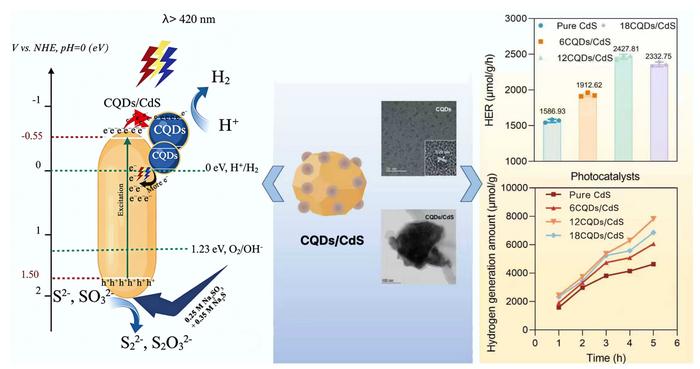
Shenyang Agricultural University has come up with a groundbreaking photocatalyst that turns plant biomass into a powerhouse for hydrogen production. They’ve developed a process that converts cellulose into tiny carbon quantum dots (CQDs) and then attaches them to cadmium sulfide (CdS) nanoparticles. The results? Almost double the hydrogen output when using visible light compared to the unmodified stuff. That’s pretty impressive!
How Can Cellulose-Derived Carbon Dots Supercharge Clean Hydrogen Production?
So, here’s the scoop: traditional CdS photocatalysts are great at soaking up visible light, but they tend to deal with a lot of drawbacks like rapid electron-hole recombination and photocorrosion, which really puts a damper on their efficiency. To tackle this problem, the researchers leveraged agricultural waste—pure cellulose powder, no less—as a renewable resource. They used a neat hydrothermal process at a moderate temperature that produced water-dispersible CQDs about 3.5 nm in size, packed with sp2-carbon cores and oxygenated surface groups. Then, they went a step further and anchored these CQDs onto the CdS, creating a dynamic interface without changing the crystal structure of the CdS. The result? Better light absorption, a slight drop in bandgap from 2.05 eV to around 2.01 eV, and much more efficient charge separation.
Subscribe to read this article for free
Continue reading on Hydrogen Fuel News → · Subscribe
What's Your Reaction?
 Like
0
Like
0
 Dislike
0
Dislike
0
 Love
0
Love
0
 Funny
0
Funny
0
 Wow
0
Wow
0
 Sad
0
Sad
0
 Angry
0
Angry
0









Comments (0)