

Ireland’s leap of faith to power data centers
In December 2025, the Irish government announced an €18.9 billion ($22.2 billion) investment package for electricity grid infrastructure out to 2030. Increasing the supply of solar electricity is a big part of the investment and Solar Ireland’s 2026 market outlook report estimates that Ireland’s total connected solar capacity will surpass 3.3 GW by year’s end, up from the current 2.7 GW. Grid investment is long overdue to ensure Ireland has the necessary transmission and distribution infrastructure to accommodate all this additional renewable capacity.
But the renewables demand is only part of the story. Ireland’s grid is overwhelmed with electricity demand from data centers, and this is driving up electricity prices for all consumers. Almost all of Ireland’s data centers are in the Greater Dublin Area (GDA).
In 2021, the state issued a moratorium on new data centers to prevent electricity blackouts in the GDA region, which covers an area of just under 7,000 square km and has a population of just over 2 million.
A few weeks after the biggest grid infrastructure investment in Irish history was announced, the government lifted the data center moratorium and in January 2026 it rolled out its Large Energy User Action Plan (LEAP). LEAP states that 10 MW-plus data centers must provide at least 80% of their energy demand through onsite new renewable energy generation and storage.
DUB20, the first LEAP campus, is already under development and will be completed in 2028 by Echelon Data Centres. But LEAP’s critics say expecting data centers to bring their own clean energy is naive and that they are likely to exploit the 20% loophole where they can, meaning more gas-fired thermal dispatchable generation for convenience.
Philip Connolly, policy manager, generation and trading at Ireland’s energy distributor ESB, said the assumption that data centers will use gas-fired generation to cover the remaining 20% is not a given. “The balance will come from the market, which will depend on the mix at the time.”
Connolly was also confident that renewable projects participating in LEAP will be shovel-ready when the data centers they are linked with enter construction. This is due to recent changes in the grid connection application process for data centers that mean they must have planning, grid and commercial agreements in place for their renewable energy projects to be granted connection.
Connolly shares his thoughts on Ireland’s energy market in his weekly newsletter, EnergyView, and has argued that Ireland’s non-domestic electricity demand is in line with other European countries. But whatever the demand, the electrons are more expensive and Irish people are feeling the pain in their pockets.
Environmental campaign group Friends of the Earth accused the government of undermining public trust and confidence in the renewable energy transition. “Research we commissioned this spring shows that households already paid €715 million in extra bills due to data centers and the pressure they place on the grid,” said the group’s data center campaign lead, Rosi Leonard.
Irish householders’ bills are directly impacted by the grid glut, and they are likely to see further increases in levies and fixed costs out to 2034 as the grid investment package is implemented, according to analysis by Aurora Energy Research. Things are going to get worse before they get better.
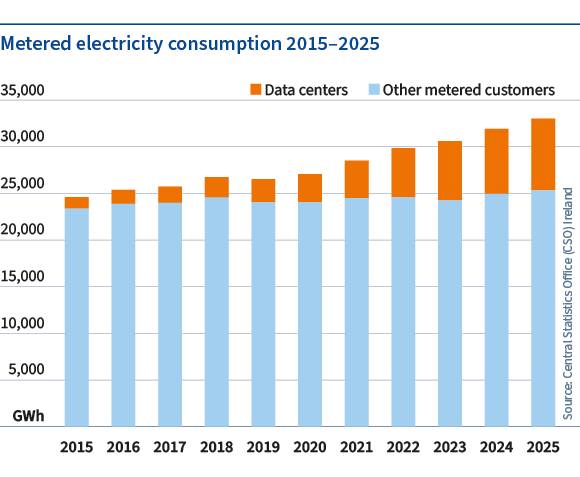
Recent figures from the Central Statistics Office (CSO) show that data centers’ metered electricity consumption accounts for almost one-quarter of national demand, which has caused public anger. Friends of the Earth asked the government to consider a temporary data center moratorium until it can show how LEAP will lead to lower electricity bills and more renewable electricity supply.
The government’s solution so far has been grants for rooftop solar and home energy upgrades. For commercial energy users, meanwhile, it has secured a €300 million state aid package from the European Commission to provide temporary electricity price relief for energy-intensive companies out to 2029. The scheme requires beneficiaries to invest at least 50% of the aid received in new assets to reduce electricity system costs without increasing fossil fuel use. Data centers are not eligible.
Economic model
Data centers are part of Ireland’s economic strategy. A March 2026 report by KPMG commissioned for Ireland’s Department of Enterprise, Tourism and Employment shows that data centers contributed approximately €2.2 billion in gross value added (GVA) to the Irish economy in 2024 alone.
“Potential rewards from sustained or accelerated data center growth offers continued gains, GVA, jobs and employment related tax revenue,” said the report.
“There are risks associated with stagnation of data center development, in which economic contributions plateau, Ireland’s competitive edge and relevance to technology companies erodes, and the delivery of essential public services and crisis response functions are constrained,” it warned.
Data center growth means further demand for electricity, KPMG’s report acknowledged. But it added that unlike the United Kingdom and Germany, which have large heavy industry bases consuming electricity, Ireland’s industrial electricity use is concentrated on supporting its digital economy. That still leaves the problem of energy, the grid and carbon impacts. The report claimed this can be turned into an opportunity for investment in large-scale renewable energy projects.
“Hyperscale facilities already underpin a material share of Ireland’s renewable corporate power purchase agreement pipeline, demonstrating their role as reliable anchor offtakers that enable developers to finance new wind and solar capacity.”
The report added that the LEAP plan provides a clear path out to 2030 that enables bankable and long-term offtake routes. “By directing large electricity loads to strategic locations with suitable infrastructure, renewable energy potential, and with options for private wire connections, grid risk will also be reduced.”
Ireland’s LEAP strategy for data centers is an opportunity to improve the grid, invest in renewable generation and build more solar. But the opportunity could very well turn into a big problem if the grid buildout is delayed or if LEAP fails.
“The question is not simply who is using electricity, but whether Ireland is building the infrastructure needed to meet growing demand sustainably,” said Ronan Power, CEO of industry association Solar Ireland.
He pointed out that data centers aren’t the only large load on the grid; demand for electrification is increasing across the board.
Ready to invest
“The debate should therefore focus on accelerating the delivery of renewable generation, electricity networks, and battery storage,” said Power. “The renewable industry is ready to invest. The challenge is ensuring that grid infrastructure and network capacity keep pace with demand and with the pipeline of renewable projects.”
Solar Ireland supports LEAP’s ambition to align the growth of large energy users with Ireland’s energy transition, said Power. “Planning electricity demand and renewable supply together is a more strategic approach than treating them separately.”
Ireland currently holds the Presidency of the Council of the European Union until Dec. 31, 2026.
“During our upcoming EU Presidency, Ireland will drive the EU’s energy agenda, including making meaningful progress on the Grids Package, the Energy Security Framework and other key files,” a Department of Energy and Climate spokesperson told pv magazine.
“The Grids Package is the most important file in the Energy Council during our presidency,” they added. “Energy markets and prices are directly impacted by events far beyond our borders. The consequences of the conflict in the Middle East underlines why we must accelerate the deployment of renewables across all sectors and continue to invest in our grid.”
Data from the Sustainable Energy Authority of Ireland (SEAI) showed the country imported almost 80% of its electricity in 2025, with much of the imported power derived from fossil fuels. This figure is significantly higher than the EU average of 57.3%, but it is still an improvement from previous years.
With the government remaining relatively gung-ho on data center growth, it’s likely that the status quo will remain. KPMG’s report said reliance on fossil fuels will persist until such a time that “sufficient firm, low-carbon technologies and long-duration storage are developed and deployed at the scale needed to replace fossil-fuel backup generation.”
“As a result, further data center expansion will continue to give rise to carbon emissions. Expanding data centers’ access to and use of renewable energy is thus essential for balancing any future growth in installed data center IT capacity in Ireland with meeting our climate goals.”
The post Ireland’s leap of faith to power data centers appeared first on pv magazine Global.
What's Your Reaction?
 Like
0
Like
0
 Dislike
0
Dislike
0
 Love
0
Love
0
 Funny
0
Funny
0
 Wow
0
Wow
0
 Sad
0
Sad
0
 Angry
0
Angry
0









Comments (0)