


Myth: Hydrogen supply chains add unnecessary complexity
 Myth:
Myth:
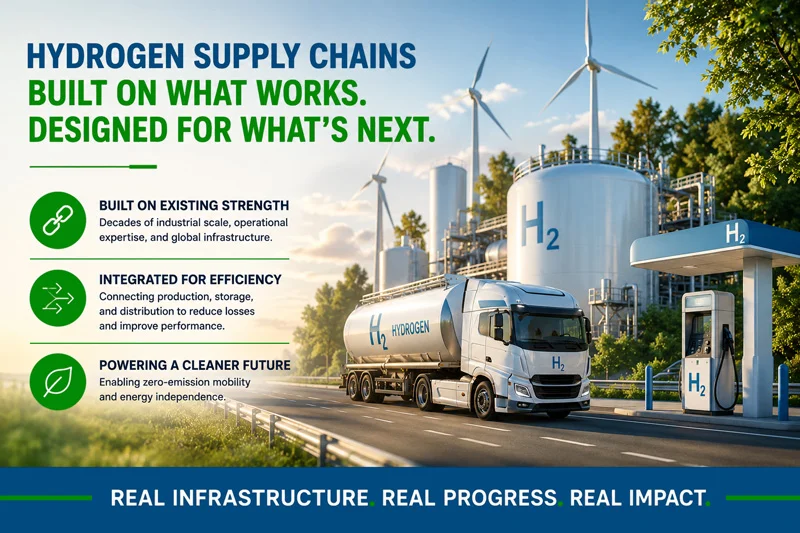
Hydrogen is often viewed as an additional energy layer—something that increases infrastructure complexity compared to electrification or existing fuel systems.
 Reality:
Hydrogen doesn’t introduce complexity so much as it reveals where today’s energy infrastructure is already fragmented—and where integration is still missing.
As part of our Hydrogen Myth vs. Reality series, we’re exploring how hydrogen fits into real-world infrastructure and commercial deployment discussions across the energy sector. These topics are frequently reflected in broader industry dialogue, including perspectives shared by organizations such as the Hydrogen Fuel Cell Partnership.
Rather than reacting to individual viewpoints, this series focuses on a practical question:
What does hydrogen infrastructure actually look like when it is deployed at scale?
Energy systems are already multi-layered
Modern energy infrastructure is not a single chain—it is a layered system of interconnected networks.
Electricity, liquid fuels, and industrial gases already operate through overlapping infrastructure models that include:
- Centralized production with distributed demand
- Long-distance transport and regional distribution hubs
- Storage systems that balance timing, volume, and variability
Hydrogen fits into this structure rather than adding a new category of complexity. It becomes another energy carrier within an already multi-vector system.
The real challenge is not introducing hydrogen—it is integrating it efficiently into systems that were never designed to optimize across multiple energy carriers simultaneously.
The real constraint isn’t supply chains—it’s system integration
Where hydrogen infrastructure challenges appear is not in isolated components, but in how those components connect.
The most common inefficiencies occur at system interfaces:
- Production sites not aligned with demand geography
- Storage acting as a passive buffer instead of an optimized node
- Transport layers stacked rather than streamlined
- Energy losses accumulating across multiple conversions
This shifts the conversation away from “building supply chains” toward designing integrated energy systems.
Infrastructure evolution is already underway
Hydrogen infrastructure is not theoretical—it is actively evolving in response to demand signals from industry and mobility.
We are already seeing:
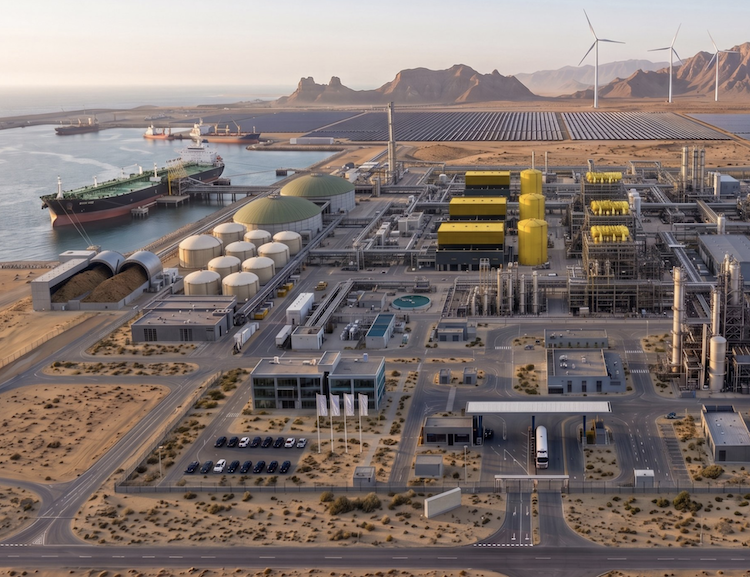
- Expansion of industrial hydrogen networks into energy applications
- Growth in liquefaction and cryogenic logistics is improving transport efficiency
- Emergence of regional hydrogen hubs closer to end-use demand
- Movement toward integrated production, storage, and distribution systems
This is not a future buildout problem—it is a present-day infrastructure transition.
Why integration now defines competitiveness
As hydrogen scales, success is increasingly determined by system efficiency rather than production capacity alone.
Key performance drivers include:
- Reducing energy losses across the supply chain
- Minimizing handling steps between production and end use
- Aligning storage architecture with real demand variability
- Improving end-to-end coordination across infrastructure layers
The advantage shifts toward systems that are better connected, not just larger.
The takeaway
Hydrogen does not introduce unnecessary complexity into energy systems.
It reveals where complexity already exists—and where current infrastructure was never designed to support multi-vector energy scaling.
The next phase of hydrogen deployment is not about adding infrastructure layers.
It is about re-architecting how those layers work together.
About GenH2
GenH2 Corp. develops liquid hydrogen infrastructure systems designed to improve storage efficiency, reduce losses, and support scalable hydrogen deployment across mobility and energy applications.
The post Myth: Hydrogen supply chains add unnecessary complexity appeared first on GenH2 Liquid Hydrogen Experts.
What's Your Reaction?
 Like
0
Like
0
 Dislike
0
Dislike
0
 Love
0
Love
0
 Funny
0
Funny
0
 Wow
0
Wow
0
 Sad
0
Sad
0
 Angry
0
Angry
0







Comments (0)