


New rules for Poland’s grid
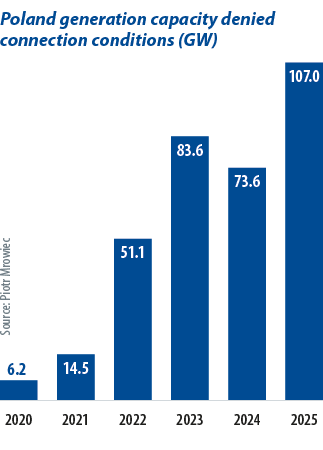
Poland’s amended Energy Act – sometimes known as the Grid Act – came into force on April 30, 2026, introducing significant changes for grid connections to generation and storage. Poland’s Ministry of Energy estimates that the new regulations could unlock the potential to connect around 150 GW of new renewables and storage capacity. New possibilities for cable pooling have been welcomed, but asset owners also face a greater financial commitment when connections are issued and implemented. Energy law expert Piotr Mrowiec outlines the new rules and provisions.
Two or more installations, including battery energy storage systems (BESS), can now share a single connection point in Poland. This provision in the new Energy Act is important for solar plant owners and creates new opportunities for asset owners. But there are new challenges too.
Poland’s cable pooling provision comes at a time of frequent curtailments and negative prices, and therefore provides a route to increased profitability for PV projects. BESS will also be allowed to charge from the grid, opening the door to flexibility markets.
Under the Grid Act, the grid operator should not charge an advance payment for processing connection applications, provided there is no increase in capacity. In practice, some grid operators are expected to charge payments anyway, citing a change in energy consumption.
The advance payment toward the connection fee has also doubled, to approximately €15 ($17)/kW of connection capacity, up to a maximum of €1.5 million. A non-refundable fee has been introduced for processing an application, €0.25 per kilowatt of connection capacity, but not exceeding €25,000.
The Act also introduces a financial security charge that projects must pay as collateral against performance obligations set out in the connection agreement. This is set at €7.50/kW of connection capacity up to 100 MW and €15/kW of connection capacity above 100 MW, not exceeding €3 million.
The implementation window for connection offers has also tightened, reduced from 24 to 12 months
Grid discipline
The Act introduced new development milestones that must be hit, too. If the grid operator is not notified of the final building permit within 24 months of the connection agreement being concluded, then the agreement expires. There are provisions for deadline extensions in cases of force majeure, or in the event of lengthy administrative proceedings. The deadline for securing permission to build can also be extended by paying an additional security deposit of €15/kW of connection capacity, up to €3 million.
There are some welcome administrative improvements. Developers should benefit from increased transparency in the connections process (electronic workflow, information platform, etc.), the submission of declarations instead of documents (title to the property, local development plan/zoning permit), as well as the possibility of changing the location of the investment – within the municipality in question, or in municipalities directly adjacent.
Time provisions
There are provisions to protect projects that have already received connection conditions or even signed a connection agreement, but these can be tricky to decipher.
Entities can essentially be divided into three groups.
Those that submitted applications before the Grid Act came into force, but had not yet received connection conditions, will be subject to new obligations. These applicants will need to pay the increased advanced payment towards the connection fee within 30 days of receiving the connection conditions, and the application processing fee by June 29.
Applicants that received grid connection conditions but had not yet entered into a grid connection agreement before the Act came into force could also be subject to higher fees, but there are caveats. The new advance payment for the connection fee – which has doubled from PLN 30 per kW to PLN 60 per kW – will apply to applicants with conditions that expire on or after Oct. 30, 2026.
Alternatively, these applicants can avoid the advance payment if they choose to pay the full value of the security payment that is withheld by distribution system operators. As a rule, the security for the performance of the connection agreement will amount to 25% of the total security amount.
Those that have already entered a grid connection agreement before the Grid Act came into force will only need to pay a performance guarantee if the connection date is after Apr. 30, 2029.
How new rules on development milestones will be applied also depends on when the connection agreement was concluded. Those signed after April 30, 2022 will have until October 2028 to obtain a final planning permission decision for the construction of a PV installation. Grid connection agreements concluded before April 30, 2022, only have until late July 2026 to obtain a final building permit.
Project developers are currently reviewing their portfolios to assess the costs of maintaining them, and to decide whether to begin construction or sell off parts of their portfolio. With the introduction of the Grid Act, renewable energy development will increasingly become the domain of more professional, larger players.

About the author
Piotr Mrowiec, LL.M., is an attorney-at-law, owner of the boutique energy law firm MROWIEC energy, and of counsel at KPMG Law. He provides expert legal counsel to numerous clients in the solar and wind energy industries. In addition to his legal practice, he is actively involved in the development of large-scale ground-mounted PV and battery storage projects in Poland. He is recognized for his expertise and has been ranked in The Legal 500 for Energy and Natural Resources.
The post New rules for Poland’s grid appeared first on pv magazine Global.
What's Your Reaction?
 Like
0
Like
0
 Dislike
0
Dislike
0
 Love
0
Love
0
 Funny
0
Funny
0
 Wow
0
Wow
0
 Sad
0
Sad
0
 Angry
0
Angry
0








Comments (0)