


Time to talk electrification
Switching energy-hungry industries to processes that run on electricity is a key step in many regional decarbonization strategies, and one that will also ensure growing demand for renewable energy sources. For many industries electrification is already underway, and as grids gear up to better manage variable generation and supply shocks, the vulnerability of fossil fuel supply chains makes the case more compelling.
An April 2026 report from Oxford University’s Environmental Change Institute (ECI) found that 90% of industrial energy demand could be electrified with existing and emerging technologies. Even so, electricity makes up only around 20% of today’s industrial energy demand. Growth of that figure over the coming years is all but assured, but the rate of growth will depend on various factors. “The technical potential for widespread industrial electrification exists; the question is whether policy acts fast enough to realize it,” explained Oxford University researcher Cassandra Etter-Wenzel.
The report finds that under the most ambitious policy scenarios, worldwide industrial electrification could reach 84% by 2050, while looking at the median of all the “high ambition” scenarios included in the study suggests 51% by 2050 could be a more realistic figure. And even under the most pessimistic scenarios, the report forecasts growth to at least 25.7% industrial electrification by 2050, if little action is taken. Reaching the higher scenarios requires industry, policymakers and energy system planners to start now. “Scenarios at the upper end consistently combine early and large-scale infrastructure investment, rapid deployment of electric process technologies (including high-temperature applications), and policy frameworks that reduce risk over long industrial asset lifetimes,” said Etter-Wenzel.
Electricity price
Recent supply shocks and price increases on the fossil fuels side make the case for electrification even stronger. Energy price spikes have companies actively looking at electrification alongside measures like demand response and increasing energy efficiency. But longer-term policies need to be in the right place for companies to see the value in switching to electricity. When fossil fuel subsidies or other interventions make this the more expensive option, industries have little incentive to move quickly toward electrification.
“Bringing down the price of industrial electricity is a precursor to electrification for most industries. During volatile periods it makes sense, but if you’re subsidizing the price of oil and gas and putting tariffs on the electricity price, it’s harder to make the case,” said Etter-Wenzel.
ECI identifies this unfavorable price ratio as the first thing holding industries back from electrification. The report notes that many regions place additional taxes and other policy costs onto electricity bills, leaving fossil fuel production with a far lower burden. “Where industrial electrification options (such as heat pumps and electric boilers) rely on low running costs to offset higher upfront investment, these distortions can materially weaken the business case and slow adoption.”
The report also notes grids are a major barrier to electrification today. Connection constraints and long wait times force some industries to reconsider. And for grid planners, industrial energy loads are often concentrated and continuous with little flexibility, making them more difficult to integrate.
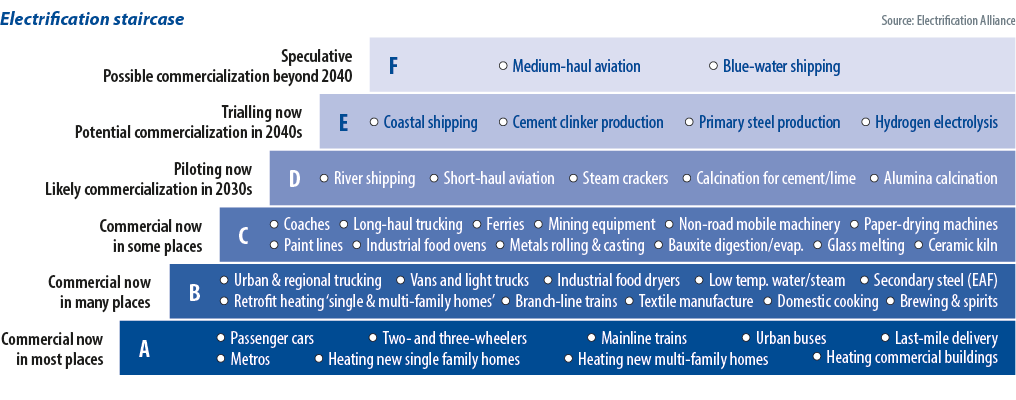
Adrian Hiel, director of the Electrification Alliance, sees this as part of an energy transition happening in stages, as outlined in the think tank’s “electrification staircase” publication (see chart, page 26). Hiel explained that, along with renewable generation and storage, electric vehicles, residential heat pumps and other technologies lower down on the staircase need to be deployed first to build more flexibility into electricity networks, ensuring that sufficient low-cost renewable electricity is available to power energy-intensive industrial processes. And like Etter-Wenzel, he advises industry and policymakers to act now. “We know electricity prices are going to come down. If you start planning electrification now, you’re going to have the pieces in place when they do. If you wait until all the pieces are there before your start looking at it, you’re going to get left behind,” Hiel told pv magazine.
In some cases, such as the recent rush to build data centers, large energy consumers themselves may be able to take on some of the costs of grid expansion, particularly where they want to get connected very quickly. For the most part though, ensuring that grids do develop with the expectation of new demand from electrifying industries in mind will be down to energy regulators. “The grid is an issue, but mostly it’s an issue for industrial electrification that’s going to take a few years to plan anyway. So we have time there,” said Hiel.
He further explained that the Electrification Alliance is involved in discussions over the upcoming EU Grids package, centered around whether grid operators can invest pre-emptively in expectation of new demand, or they need to wait until they have a certain amount of demand confirmed before moving to upgrade or build new infrastructure. “Ultimately, you’re talking about changing the way grid operators invest. And these are heavily regulated businesses, so you need to get national regulators on board,” he said.
Hiel is hopeful that the latest fossil fuel crisis will prove a catalyst. “It doesn’t take a genius to see that the solution is using more of the free electricity we have all of the time. It’s a matter of putting processes in place to help people do that,” he said, noting that rolling out smart meters and services to help companies identify opportunities to electrify would be an important step toward this.
Industrial policy
Scenarios in the ECI report that achieved the highest rates of electrification were all based on policies that focus on both decarbonization and economic growth. “They have this dual imperative to reduce emissions and to ensure they are industrially competitive. They’re realizing that if you don’t produce fossil fuels yourself, domestic energy production will help your industry a lot more in the long run,” said Etter-Wenzel.
Those with the lowest rates were characterized by low progress on emissions reduction and clean electricity availability, weak policy signals on fossil fuel phase-out, slow industrial turnover, and preference for carbon capture and storage.
High-temperature heat
Hiel said that today many industries are already engaging with electrification plans, particularly less energy-intensive sectors like the food and beverage industry. For larger energy consumers such as glass or metals production and others requiring high temperature heat, the picture is more complex. Mature technologies exist to convert many of these processes to run on electricity, but the low-cost electricity that would make it a viable business case has not yet arrived. “It’s not like you can’t have a ceramic kiln or furnace that uses electric radiant heat. But these are so energy intensive that until we get to a place where we have a lot of flex in the system and consistently low energy prices, doing that is going to be expensive,” Hiel explained.
The ECI report made similar findings, noting that “industries with predominantly low- and medium-temperature heat needs show strong electrification potential with commercially available technology today and could serve as near-term demonstration cases for the broader industrial transition.”
The report examined steel and cement production as examples of industries requiring high-temperature heat, and found a very wide range of forecast scenarios for the 2050 electrification of these industries, from below 15% all the way to near 100% for cement, and between around 20% and just over 60% for steel. Etter-Wenzel explained that the more dispersed outcomes for cement compared to steel reflect that electric equipment and processes for steel production are more advanced, while some used to produce cement might require major redesigns to be able to run on electricity.
With renewable energy already widely available in many regions, and grids beginning to deploy storage and improve their ability to manage variable generation, the case for various industries to electrify is only getting stronger. Hiel views this as a new stage in the energy transition. “It took us 20 years to disrupt the energy sector with new technologies, policy frameworks and all of that. Now we have a different challenge,” he said.
This industrial electrification challenge may seem bigger, disrupting multiple sectors beyond energy itself, but Hiel expects it to move much faster. “We’re well positioned in terms of economics and technology. And then you have the motivation that comes from our second fossil fuel crisis in four years, that leaves you with the obvious choice to push for electrification,” he said.
The post Time to talk electrification appeared first on pv magazine Global.
What's Your Reaction?
 Like
0
Like
0
 Dislike
0
Dislike
0
 Love
0
Love
0
 Funny
0
Funny
0
 Wow
0
Wow
0
 Sad
0
Sad
0
 Angry
0
Angry
0








Comments (0)