


EU-funded project validates tech that converts biogas into hydrogen and solid carbon
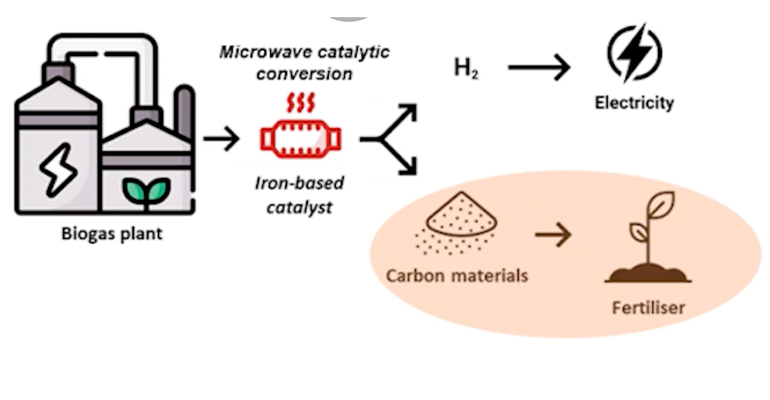
Launched in 2024, the project “TITAN – Direct biogas conversion to green hydrogen and carbon materials by scalable microwave heated catalytic reactor for soil amendment and silicon carbide production” aimed to help address two major challenges on Europe’s path to climate neutrality by 2050: reducing emissions from sectors that are difficult to decarbonise, particularly agriculture, and increasing the supply of renewable hydrogen needed by industry, transport and energy systems.
The TITAN project consortium comprises three academic research centers/universities, three SMEs and the European Biogas Association (EBA) developed and validated a process that uses microwave energy to convert biogas into a hydrogen-rich gas and solid carbon materials.
Single system with 85 percent conversion rate
The process combines several reaction steps into a single system, reducing the need for additional gas treatment and separation processes.
During the project, the technology was successfully validated at Technology Readiness Level 5 (TRL 5), demonstrating stable operation under conditions representative of real biogas streams.
The system achieved methane conversion rates above 85 percent and maintained consistent performance over repeated operating cycles.
The carbon produced during the process forms an iron-carbon material that was assessed for potential applications. Project studies found no significant negative effects on the soil microorganisms and soil fauna that were examined.
Additional studies using carbon tracing techniques showed very limited breakdown of the material in soil, indicating strong potential for long-term carbon storage.
Competitive with electrolysis of water
Results also indicate that, on a large scale, hydrogen could be produced at costs competitive with renewable hydrogen from water electrolysis. For large facilities, production costs of around €4.5 per kilogram of hydrogen were estimated.
In locations with low-cost electricity, costs could fall to around €3.9 per kilogram.
The project found that the process uses electricity more efficiently than water electrolysis. Across the scenarios assessed, TITAN produced between 51 and 57 grams of hydrogen per kilowatt-hour of electricity consumed, compared with around 20 grams per kilowatt-hour for water electrolysis.
According to the TITAN roadmap, the technology could potentially enable the production of up to 0.6 million tonnes of hydrogen per year by 2030, rising to almost 4 million tonnes per year from 2045 onwards.
Project estimates indicate that cumulative greenhouse gas (GHG) savings could reach 237 million tonnes of carbon dioxide (CO2) by 2045.
The TITAN project also identified several policy areas that could support future deployment. These include recognising biohydrogen as renewable hydrogen within EU legislation and creating appropriate regulatory frameworks for the use of solid carbon materials in agriculture and carbon storage applications.
TITAN has demonstrated that biogas can play a broader role in Europe’s energy transition. Over the past three years, the project has validated a process that produces renewable hydrogen while generating solid carbon materials with potential for long-term carbon storage. These results provide a strong foundation for further scale-up and show how biogas resources can contribute to Europe’s climate and energy objectives, said Dr David Farrusseng, Project Coordinator of TITAN.
What's Your Reaction?
 Like
0
Like
0
 Dislike
0
Dislike
0
 Love
0
Love
0
 Funny
0
Funny
0
 Wow
0
Wow
0
 Sad
0
Sad
0
 Angry
0
Angry
0




Comments (0)