


FCHEA Member Guest Blog: Fueling the Data Center Fuel Cell
by Jason Barney, Renewable Innovations
October 26, 2026
The question operators ask first
When a data center team looks seriously at hydrogen fuel cells, the hard question is rarely whether the fuel cell works. Microsoft ran a 250 kW hydrogen system at full load for 24 hours non-stop, then for 48 consecutive hours in 2019 and 2020, powering about ten racks of servers, and put a 3 MW system built by Plug Power through its diesel-generator acceptance tests in 2022. The team behind the 250 kW tests was led by Robert Mount, now CEO of Renewable Innovations, an FCHEA Board member. The hard question is where the hydrogen comes from, how much has to be on site, and what happens on day three.
That question is getting more urgent. Data centers used about 4.4% of US electricity in 2023 and could use 6.7% to 12% by 2028, according to the Berkeley Lab report released by DOE. Marsden Hanna, Google’s global head of sustainability and climate policy, said in January 2026 that utilities in many markets quote “four or five, sometimes ten years to interconnect.” New generation to serve that load waits too: in regions with data, projects completed in 2025 took a median of more than five years from interconnection request to commercial operation.
Sites that cannot wait are turning to power they generate and control. That puts fuel logistics at the center of the decision. The arithmetic takes three steps: load to kilograms, kilograms to reserve, reserve to delivery.
At a glance
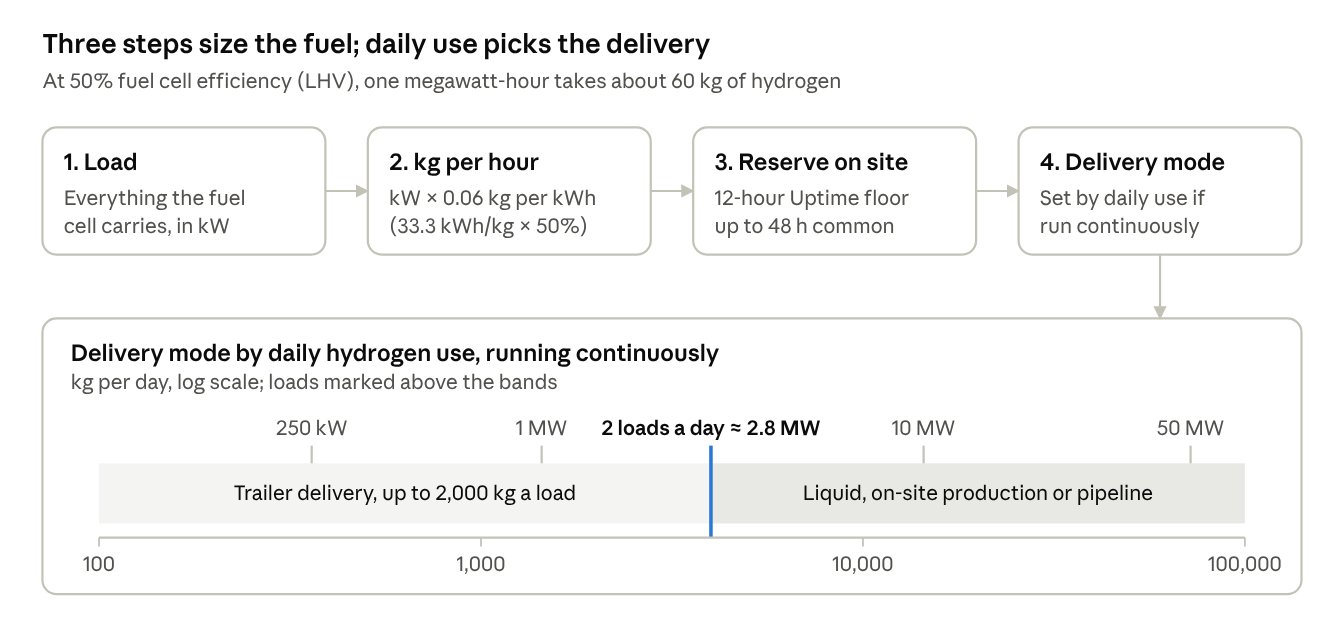
How to size hydrogen supply for a data center, at 50% fuel cell efficiency (LHV). Diagram: Renewable Innovations
Size the fuel from the load, hold 12 to 48 hours on site, and let daily use pick the delivery. Run continuously above about 3 MW, trailer deliveries pass two a day and bulk supply starts to make sense.
Step 1: From load to kilograms
The rule of thumb: one megawatt-hour of electricity from a hydrogen fuel cell takes about 60 kg of hydrogen. In Renewable Innovations’ testing, a 1 MW load running for 24 hours used about 1,600 kg, with each kilogram delivering 13 to 19 kWh depending on how heavily the fuel cell was loaded.
A kilogram of hydrogen holds 33.3 kWh of energy on a lower-heating-value (LHV) basis. DOE’s 2015 status for small (1–10 kW) fuel cell backup systems was 50% electrical efficiency (LHV), against a 60% target for 2020. At 50%, each kilogram yields about 16.7 kWh, or 0.06 kg per kWh. DOE measures DC output, so inverter losses and stack aging come on top.
Kilograms of hydrogen = load (kW) × hours ÷ (33.3 × efficiency)
Load means everything the fuel cell carries, cooling included, not IT load alone. Real efficiency moves with load, temperature and stack age. A planning range of 45% to 55% gives 15 to 18 kWh per kilogram, or 55 to 67 grams per kWh. Ask each vendor for measured efficiency across the site’s expected load range.
Step 2: How much to keep on site
Diesel practice sets the benchmark at 12 to 48 hours of fuel at design load.
- Uptime Institute’s Tier Standard requires at least 12 hours of on-site fuel for every Tier, counted only from storage that stays available when redundant components are out of service.
- NFPA 110, which governs emergency and legally required systems, classes them by hours of run time without refueling. Its preset classes run up to 48 hours; other run times are set as Class X.
- Microsoft described 12 to 48 hours of backup fuel as industry standard when it announced its 2020 test.
Hydrogen changes two things. First, the right reserve depends on how fast the supply chain can resupply during a regional outage, not just on tank size. A site a few hours from a hydrogen source may justify less than one at the end of a long route, though not below the 12-hour floor, and only if the supplier’s own production and dispatch stay up through the same regional event.
Second, it changes the role. Diesel backup is normally permitted as emergency equipment, and EPA rules let emergency engines run up to 100 hours a year for maintenance, testing and limited other uses, and Microsoft reported its generators cover an outage less than once a year. Combustion units can run as bridge or prime power, but under stricter non-emergency permits. Fuel cells fall outside those engine rules, which can simplify permitting for daily operation, though local requirements still apply. Once a fuel cell runs every day, the reserve question becomes a daily supply question, and fuel price comes to the fore: at 60 kg per MWh, every $1 per kg of hydrogen adds about $60 per MWh.
Step 3: How it arrives
The delivery mode follows the daily volume. A 1 MW load running around the clock uses about 1,440 kg a day, under one load from a 2,000 kg trailer, or two from a 900 kg one. At 10 MW it is about 14,400 kg a day, or eight 2,000 kg loads.
| Mode | Payload | Fits best |
| Steel tube trailer | About 210–220 kg delivered, in Renewable Innovations’ experience | Older design, limited by the weight of steel and by pressure |
| High-pressure composite trailer (virtual pipeline) | 560–900 kg in DOE’s figures; up to 2,000 kg in the newest units | Backup at all scales shown here; bridge or prime power to about 3 MW |
| Liquid hydrogen tanker | More than 4× a high-pressure tube trailer | Continuous loads above about 3 MW; boil-off to manage in storage |
| On-site electrolysis | Continuous; about 55 kWh of electricity per kg (DOE 2022 status) | Sites with renewable or off-peak power to spare |
| Pipeline | Continuous | The few sites near existing hydrogen pipelines |
Older steel tube trailers were limited in both capacity and pressure. The newer approach, often called a virtual pipeline, uses high-pressure composite trailers as the on-site storage itself: a full trailer is parked and connected, then swapped for another when its pressure falls to a set level. Renewable Innovations builds them from a 40-foot trailer carrying 800 kg up to a 53-foot trailer carrying 2,000 kg at 960 bar. DOT limits tube trailers to 250 bar, with exemptions allowing 500 bar or more, so payload also depends on pressure rating.
On-site electrolysis turns the question around: it moves hydrogen supply onto the power bill. DOE’s 2026 target is 51 kWh per kg, so producing a kilogram costs about three times the electricity a fuel cell returns from it. Running a 10 MW fuel cell around the clock would take 30 to 33 MW of electrolysis, which a site short of grid power does not have. The trade suits sites with surplus or curtailed power at some hours.
Worked examples
With 2,000 kg trailers, a 10 MW site needs four for a 12-hour reserve and 15 for 48 hours. Run continuously above about 3 MW, deliveries pass two a day, which is where liquid supply or production near the site starts to make sense.
| Load | Hydrogen per hour | 12-hour reserve | 48-hour reserve | 2,000 kg trailers for 48 hours | Daily use, running continuously |
| 250 kW | 15 kg | 180 kg | 720 kg | 1 | 360 kg |
| 1 MW | 60 kg | 720 kg | 2,880 kg | 2 | 1,440 kg |
| 10 MW | 600 kg | 7,200 kg | 28,800 kg | 15 | 14,400 kg |
| 50 MW | 3,000 kg | 36,000 kg | 144,000 kg | 73 | 72,000 kg |
Assumes 50% fuel cell efficiency (LHV) and 2,000 kg per trailer, the largest current units. Trailer counts are worked from unrounded figures and rounded up, and assume the full payload is usable. Fuel cell systems that run on inlet pressures of 10 bar or less leave little gas behind in each trailer, which keeps that close to true. With 900 kg trailers, counts are a little over twice as high. At 45% or 55% efficiency, the kilogram figures move by about 10%.
On these assumptions, Microsoft’s estimate that a single data center could need up to 100,000 kg of hydrogen for a 48-hour outage corresponds to roughly 35 MW of load. Using the 15 to 19 kWh per kilogram in Renewable Innovations’ recorded figures, a 35 MW site would need roughly 88,000 to 112,000 kg for 48 hours at full load.
Siting and codes
The reserve size sets the storage footprint, and the footprint sets the permitting conversation. Requirements come from the fire code a jurisdiction has adopted. NFPA 1 refers to NFPA 2 for hydrogen, the International Fire Code has its own section on stationary fuel cell systems, and NFPA 853 covers fuel cell installation (UL Code Authorities). NFPA 2, the Hydrogen Technologies Code, covers the generation, installation, storage, piping, use and handling of hydrogen as compressed gas or cryogenic liquid. Its newest edition is 2026, but local adoption often lags, so check which editions are in force.
The local fire official, the authority having jurisdiction, applies it. Bring them in at concept stage, with a reserve figure and a delivery plan in hand, rather than at permit submission. Plan for connected trailers to count as on-site storage. Separation distances, trailer positions and delivery routes are far easier to settle before a site layout is fixed.
What it means
At the 12-hour minimum and at smaller sites, trailer logistics fit the reserve norms data centers use today. Forty-eight-hour reserves at tens of megawatts imply large storage footprints or liquid supply. For bridge and prime power, where the interconnection queue is pushing operators, supply is the deciding question. That is where the industry’s next build-out lies: delivery capacity, liquid supply, and production close to load. Some operators will start on natural gas instead; AEP’s agreement for up to 1 GW of Bloom Energy solid oxide fuel cells for data centers runs on gas first, with hydrogen as a possible later option.
Five questions worth putting to any hydrogen power supplier:
- What is the measured electricity output per kilogram across our load range, and what hydrogen purity does the system need?
- How many hours of reserve will sit on site, and how fast can you resupply during a regional outage?
- Which delivery mode fits our daily volume, how much of each delivered load is usable, and who owns and maintains the trailers or tanks?
- What storage pressure and footprint does that imply, and what separation distances apply under NFPA 2?
- What happens if a scheduled delivery is missed?
Sources
- Microsoft, “Microsoft tests hydrogen fuel cells for backup power at datacenters”, 27 July 2020. 250 kW test, 48 hours; 12–48 hours of fuel as standard; up to 100,000 kg for 48 hours; diesel use under once a year.
- Data Center Dynamics, “Microsoft builds 3MW hydrogen fuel cell backup power plant”, 29 July 2022.
- US DOE, “DOE Releases New Report Evaluating Increase in Electricity Demand from Data Centers”, 20 December 2024.
- Network World, “Google warns grid connection delays are now the biggest threat to data center expansion”, 15 January 2026.
- Lawrence Berkeley National Laboratory, Queued Up: 2026 Edition, May 2026.
- DOE Hydrogen Program, Record 9013, energy requirements for hydrogen compression and liquefaction, July 2009. LHV of 33.3 kWh/kg.
- US DOE, “DOE Technical Targets for Fuel Cell Backup Power Systems”.
- Uptime Institute Journal, “Fuel System Design and Reliability”, Kevin Heslin, 18 June 2014.
- Consulting-Specifying Engineer, “NFPA 110-2019 concepts and changes”, John Yoon, 15 November 2019.
- US EPA, RICE NESHAP requirements for stationary engines at area sources, September 2013.
- US DOE, “Hydrogen Tube Trailers”.
- DOE Hydrogen Program, Record 20007, hydrogen delivery and dispensing cost, August 2020.
- US DOE, “Technical Targets for Proton Exchange Membrane Electrolysis”.
- ANSI Webstore, NFPA 2-2026, Hydrogen Technologies Code.
- UL Code Authorities, “Stationary Fuel Cell Power Systems – 2018 Requirements”, 19 December 2017.
- AEP, news release on up to 1 GW of Bloom Energy fuel cells, 14 November 2024.
- Renewable Innovations, Virtual Pipeline.
The post FCHEA Member Guest Blog: Fueling the Data Center Fuel Cell appeared first on FCHEA.
What's Your Reaction?
 Like
0
 Dislike
0
 Love
0
 Funny
0
 Wow
0
 Sad
0
 Angry
0




Comments (0)