


Follow the money
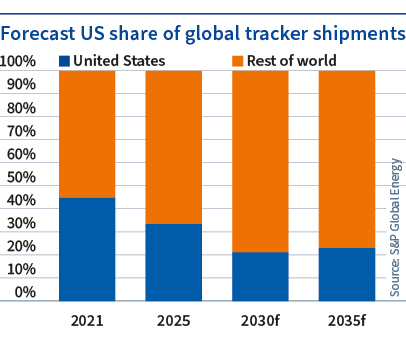
Solar trackers are, in a sense, a victim of their own success in the North American market. They have become the default technology for utility-scale projects with a market penetration rate of over 90%. This saturation has created its own challenge – with the domestic market close to fully saturated, there is little room for growth. US tracker shipments are forecast to decline annually from 2026 to 2035.
Over the past decade, the underlying technology of solar trackers has matured. While proprietary algorithms, software and terrain-following capabilities still provide differentiation, the core mechanical components have become increasingly commoditized, making it challenging to compete on hardware alone.
This market plateau is compounded by the solar capex ceiling. Mounting systems represent only around 10% of the total capital expenditure for a US utility-scale solar project, so tracker vendors remain locked out of 90% of the capital deployed on every project they supply. Expanding into adjacent components offers a lucrative opportunity to unlock new revenue streams.
Capital stack
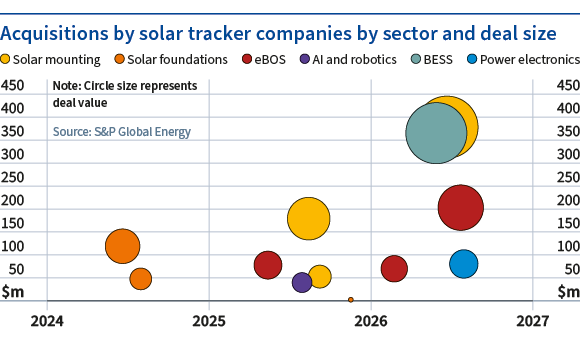
Mergers and acquisitions (M&A) deal size and frequency increased considerably in 2025 and 2026, revealing a clear strategic evolution. While initial acquisitions focused on adjacent components like solar foundations and fixed-tilt systems, the focus has since shifted toward high-value, non-core components. Some tracker suppliers have expanded into battery energy storage systems (BESS), power electronics, robotics, and electrical balance of systems (eBOS), signaling a strategy to build a comprehensive, integrated solar offering with an increasing focus on grid interaction.
Expanding into non-core components unlocks new revenue streams. Installation robotics, for example, would enable tracker suppliers to capture a share of installation costs, which represent the largest cost component of solar project capex in the United States. Similarly, integrating components such as energy storage opens entry points into hyperscale and enterprise data center power portfolios. The global front-of-the-meter energy storage market is forecast to grow at 18.3% compound annual growth rate (CAGR) between 2026 and 2035.
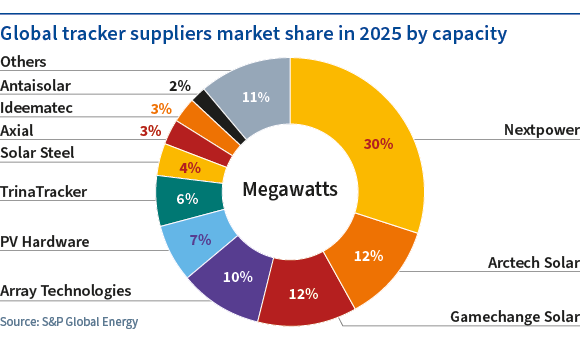
The tracker industry’s M&A activity has been led by three of the largest global tracker suppliers: NextPower, Array Technologies, and GameChange Energy, all of which are headquartered in the United States. NextPower has been the frontrunner, spending more than $1.1 billion to transform from a component supplier into a full-system provider. The company’s strong cash position, along with a significant line of credit, has given it the ability to expand rapidly.
Integrated systems
Utility-scale developers and EPCs face multi-vendor fragmentation, interface risks, and increased installation costs during commissioning between tracker, inverter, cabling, and battery suppliers. To ease installation complexity, developers are increasingly prioritizing suppliers that include mechanical, electrical, and control interfaces in a single package and offer installation savings through plug-and-play systems that minimize the complexity and time-cost of cross-component installation.
In the United States, solar suppliers can also benefit significantly from tax credits by onshoring component manufacturing. The Section 45X credit is a direct, per-unit subsidy paid by the US federal government to companies that manufacture clean energy components in the United States and sell them to unrelated third parties. Unlike traditional credits that offset tax liability, 45X credits are eligible for direct cash payments, effectively acting as a subsidy rather than a tax exemption.
The US domestic content tax bonus also incentivizes suppliers to manufacture locally. The bonus grants developers a 10% tax credit if solar installations use a required share of US-manufactured components.
Solar suppliers are also incentivized to localize manufacturing through the domestic content bonus credit, which grants developers a 10% tax credit if solar installations use a required share of US-manufactured components. By creating supply chains in the United States, tracker suppliers gain a competitive advantage and can command premium pricing by enabling access to the bonus credit.
The rebranding of major players – NextTracker to NextPower and GameChange Solar to GameChange Energy – is also evidence of a market shifting from individual components toward integrated solutions.
Global expansion
The tracker growth challenge is not limited to the United States, but whether this trend of acquisitions will spread into other markets remains uncertain. The European Union’s Carbon Border Adjustment Mechanism (CBAM), which entered into force in January 2026, imposes carbon costs on imported materials. As regulation evolves, European tracker suppliers may also localize their supply chains to protect their margins from increasing carbon duties, potentially leading to acquisitions within the European solar supply chain.
The US tracker M&A wave may be more than an isolated burst of dealmaking and instead may suggest a shift from single component vendors to integrated renewable energy providers. Ultimately, success will depend on the ability of tracker companies to convince customers that their integrated offer is better than a multi-vendor solution.
The post Follow the money appeared first on pv magazine Global.
What's Your Reaction?
 Like
0
Like
0
 Dislike
0
Dislike
0
 Love
0
Love
0
 Funny
0
Funny
0
 Wow
0
Wow
0
 Sad
0
Sad
0
 Angry
0
Angry
0









Comments (0)