


MicroQuanta, Zhejiang University achieve world-record efficiency of 23.9% for 19.48 cm² perovskite solar module

A research team led by scientists from Chinese perovskite solar cell manufacturer MicroQuanta Semiconductor has achieved a certified steady-state efficiency of 23.9% for a 19.48 cm² perovskite mini-module, setting a new world record.
The researchers said the result was enabled by cooling the wet perovskite precursor film before vacuum treatment to slow crystallization and reduce the fill factor losses associated with scaling up from cells to modules.
“What makes our result special is that the world record is achieved at the module level, rather than in a small laboratory cell,” corresponding author Dongchen Lan told pv magazine. “Solar cells often lose efficiency when scaled up into modules.”
The result was certified by the National PV Industry Measurement and Testing Center (NPVM) of China’s Fujian Metrology Institute.
Lan said the team identified a major cause of these losses and demonstrated a way to mitigate them while helping modules maintain their performance over time. “This addresses a key challenge in bringing next-generation solar technologies closer to practical use,” he said.
The researchers first compared laboratory-scale perovskite solar cells with mini-modules fabricated under matched processing conditions in previous studies. They used Shapley value analysis, which averages the contribution of each parameter across all possible orders of substitution, to quantify the contributions of open-circuit voltage, short-circuit current density, and fill factor to the measured efficiency loss.
After accounting for current losses in inactive areas created by laser scribing, they found that fill factor was the largest contributor to the efficiency drop from cells to modules.
To reduce that loss, the team spin-coated a perovskite precursor onto indium tin oxide (ITO)-coated glass carrying two hole-transport layers (HTLs). Immediately after coating, they cooled the wet film for 15 seconds to 0-10 C, transferred it to a vacuum chamber within about five seconds, and vacuum-flashed it for two minutes before annealing it at 110 C for 30 minutes. They then applied a surface passivation layer and deposited the electron-transport layers (ETLs) and silver (Ag) electrode. Measurements during film formation showed that cooling slowed the conversion of an intermediate phase into perovskite, yielding films with larger, more uniform grains.
The researchers used slot-die coating to fabricate a 19.48 cm² perovskite mini-module consisting of eight subcells connected in series through laser scribing. The device was built on a glass substrate coated with indium tin oxide (ITO), nickel oxide (NiOₓ), and a self-assembled monolayer known as 3PATAT-C3. It featured a formamidinium-cesium lead iodide (FA₀.₉₅Cs₀.₀₅PbI₃) absorber with an ethylenediammonium diiodide (EDAI₂) surface passivation layer, a fullerene (C₆₀) electron transport layer, a bathocuproine (BCP) buffer layer, and a silver (Ag) electrode.
According to the team’s measurements, the mini-module achieved a certified steady-state efficiency of 23.9% and a fill factor of 83.3%, which the authors reported as the highest for a perovskite module. It also had a geometric fill factor of 97%, meaning 97% of its aperture area was photoactive. In separate aging tests under continuous one-sun illumination at open-circuit, the efficiency loss attributable to declining fill factor was less than one-third as large in modules made with the cooling step as in control modules.
“The resulting fill factor advantage is retained across device scales and during operation, revealing a shared parameter-level pattern between scale-up loss and operational decay,” the group concluded. “Hence, preserving fill factor offers a unifying optimization target for developing efficient, stable and scalable perovskite photovoltaics.”
The cell was described in the study “Retarding efficiency loss upon scaling in perovskite photovoltaics as fill factor becomes the bottleneck,” published in nature communications. Researchers from China’s MicroQuanta Semiconductor, Zhejiang University, China Three Gorges Renewable, Zhejiang Provincial Key Laboratory of Optoelectronic Functional Materials and Devices, and the Australian Centre for Advanced Photovoltaics.
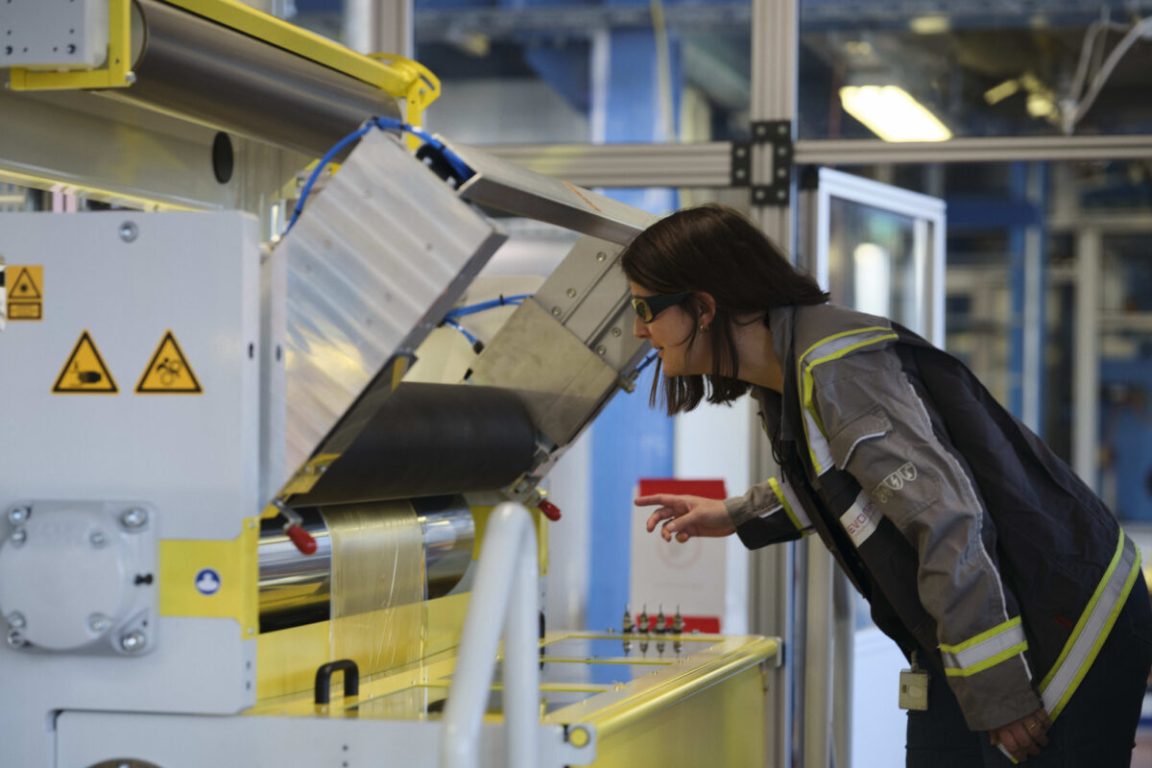
In January 2025, MicroQuanta achieved a certified efficiency of 21.86% for an 810 cm² perovskite solar module. The company has also been developing a gigawatt-scale perovskite production line in Quzhou, Zhejiang province, with plans to manufacture large-area modules measuring 2.88 m² and targeting 20% efficiency and a 25-year lifespan.
More recently, MicroQuanta introduced a perovskite-silicon tandem module for building-integrated photovoltaics (BIPV) at The smarter E Europe 2026 in Munich, Germany. The four-terminal MQ-α² series features a reported efficiency of 26% and power outputs ranging from 65 W to 165 W. The modules are available in customizable colors and finishes.
The post MicroQuanta, Zhejiang University achieve world-record efficiency of 23.9% for 19.48 cm² perovskite solar module appeared first on pv magazine Global.
What's Your Reaction?
 Like
0
 Dislike
0
 Love
0
 Funny
0
 Wow
0
 Sad
0
 Angry
0










Comments (0)