

Solar powerhouse to storage leader
Chile’s solar generation capacity had reached 12 GW by the end of 2025, making it the largest renewable technology in the national electricity mix. Now the focus is on building battery storage capacity to rescue PV capacity and leveraging the imbalances generated by that accelerated overbuild.
The rapid concentration of utility-scale solar plants in northern Chile outpaced the ability of the transmission network to transport electricity to the country’s largest demand centers, which are located hundreds of kilometers to the south.
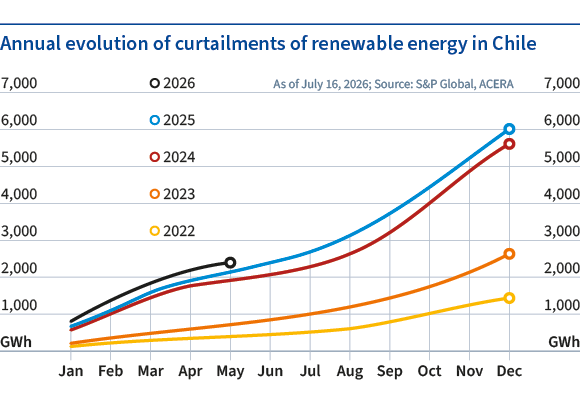
The problem becomes most apparent during midday hours. At peak solar production, electricity supply frequently exceeds the system’s ability to absorb and transport power. Grid operators are therefore forced to curtail renewable generation, disconnecting solar and wind plants even when resource conditions are favorable. Renewable curtailment exceeded 6 TWh in 2025, according to the Chilean Association of Renewable Energy and Energy Storage (ACERA), continuing a trend that has accelerated rapidly over the last several years. During the first five months of 2026 alone, renewable curtailment already surpassed 2.4 TWh, up 16% from the same period a year earlier.
This phenomenon has altered electricity price dynamics. As solar energy floods the market during daylight hours, marginal prices increasingly collapse toward zero and occasionally become negative. Solar plants therefore produce the highest volumes of electricity during periods when electricity has the lowest economic value.
Curtailed generation represents lost revenue for project owners and raises concerns about the long-term profitability of standalone solar assets. The financial viability of new solar projects depends on their ability to manage curtailment exposure and capture higher-priced market periods.
Battery buildout
In this context, battery energy storage systems (BESS) have emerged as one of the most important solutions to Chile’s challenge of integrating renewable energy.
By storing excess solar generation during periods of oversupply and discharging it during evening demand peaks, batteries effectively move energy from low-value hours to high-value hours. Instead of curtailing clean electricity, project owners can capture and monetize energy that would otherwise be wasted.
Chile first established incentives for standalone storage participation through legislation passed in 2022 and has continued to introduce reforms that facilitate battery integration into both utility-scale and distributed-generation markets.
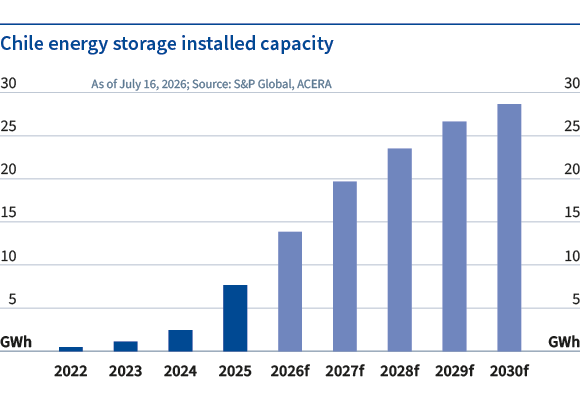
The pace of deployment has already exceeded previous policy expectations. Chile’s original goal of reaching 2 GW of storage capacity by 2030 was achieved five years ahead of schedule. As of June 2026, the country already has more than 3 GW of battery storage in operation, and over 1 GW undergoing testing.
S&P Global highlights an expanding energy storage pipeline, with more than 20 GWh under construction and projected to surpass 28 GWh by 2030. This reflects accelerating build-out momentum and the increasingly strategic role of storage in the evolution of the power market.
Major projects such as Grenergy’s Oasis de Atacama, Zelestra’s hybrid storage developments, CIP’s Patache project, and several utility-scale battery installations from AES Andes, ContourGlobal, Sonnedix, and Innergex illustrate the scale of investment currently flowing into the sector. Many of these projects are among the largest battery installations in Latin America and are specifically designed to address solar curtailment and evening peak demand.
In June 2026, Chile released the first power auction framework explicitly allowing standalone storage systems to participate alongside generation assets. The tender framework allows storage systems to participate as contracted supply resources, subject to requirements on withdrawals, backup capacity, and short-term market activity. For hybrid projects, energy from a renewable plant must be accounted for separate storage discharge.
The auction launched in July 2026, with bids due on Dec. 4, 2026. Economic offers will be opened on Jan. 5, 2027, and awards will be announced on Jan. 13, 2027.
Chile’s renewable energy challenge from 2026 onward is a surplus of solar generation. Batteries have emerged as the primary tool for addressing curtailment, price cannibalization, and system flexibility needs, yet batteries alone will not solve the country’s integration challenge. Transmission expansion remains essential, particularly the development of critical infrastructure projects such as the Kimal-Lo Aguirre transmission corridor. The long-term success of Chile’s energy transition will depend on the combined deployment of storage, transmission, market reforms, and demand-side electrification.
About the author

Ángel Cancino is a senior research analyst at S&P Global and a member of the clean energy technology team. His work includes creating forecasts and market development analyses for emerging and established renewable energy markets. His current research focuses on the solar and BESS markets in Latin America and the Iberian Peninsula, including project identification, regulatory frameworks, and the key drivers behind renewable energy growth in the region.
The post Solar powerhouse to storage leader appeared first on pv magazine Global.
What's Your Reaction?
 Like
0
Like
0
 Dislike
0
Dislike
0
 Love
0
Love
0
 Funny
0
Funny
0
 Wow
0
Wow
0
 Sad
0
Sad
0
 Angry
0
Angry
0







Comments (0)