


The silicon recycling loop remains open
Retrieving silicon from end-of-life PV modules for reuse in solar applications relies heavily on small improvements. As scientists continue to chase that decimal point, AI and robotic labs might beat them to the goal.
Recovering silicon from end-of-life solar modules is becoming easier in terms of yield, but returning it to a purity level suitable for new solar cells remains a far more difficult challenge. To close the loop and have old modules feed into the production line of new cells, recyclers need to achieve a silicon purity level of at least 99.9999% (6N). As solar panels were designed to last for decades, with tightly bonded layers of glass, polymers, metals, and coatings, recovering silicon with almost no impurities in an environmentally and economically viable way remains a significant obstacle.
“The purity question is one the industry has often answered with more optimism than the underlying chemistry supports,” André Pujadas, CEO of US-based solar recycling company OnePlanet, told pv magazine. “No recycling process today, at commercial scale, produces silicon meeting the solar-grade polysilicon specification. At OnePlanet, we target a purity level of at least 95%, which qualifies as a precursor to metallurgical-grade silicon. That grade is the established input material for producing solar-grade polysilicon via the Siemens process, a silicon purification method.”
For outsiders to the silicon industry, the difference between 95% and 99% purity might seem small, let alone the additional decimal places separating 99.99% from 99.9999%.
“To get to a solar-grade level, the recovered silicon would require further refining and extremely tight control of metallic, carbon, oxygen, dopant, and other impurities,” explained Pietrogiovanni Cerchier, CEO of Italian PV recycling company 9-Tech. “At present, such purification processes are too expensive, and the market demand does not yet justify the additional cost.”
Robots and AI
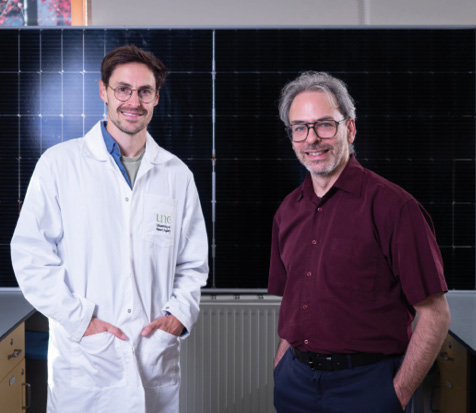
A team from the Netherlands Organization for Applied Scientific Research (TNO) is currently working to make such a process economically viable. Led by Mirjam Theelen, the group has developed the novel “laser-assisted recycling of solar modules” (LARS) method. Their process uses lasers to selectively weaken the bond between silicon cells and the surrounding encapsulant while simultaneously removing the silicon nitride (SiNx) coating from the wafer surface. This allows recyclers to separate cleaner silicon and silver without shredding the module into mixed material fractions.
Theelen explained that in their most recent testing, the team achieved a silicon purity of up to 99.997% with a yield of 97% by combining the LARS procedure with a subsequent wet-chemical step. Although those levels do not yet make the cut for solar-grade silicon, the novel process stands out from an industrial standpoint. It is applicable to all crystalline silicon module types, including Al-BSF, PERC, TOPCon, IBC, curved modules, and modules with polymer front sheets, while requiring very low energy: below 0.2 kWh per older residential module and below 0.5 kWh for larger modern bifacial modules. Theelen said that these levels make operating electricity costs relatively insignificant, shifting the main economic consideration in recycling toward capex.
“By further optimization of the chemical post-treatment process and/or accepting a lower silicon yield, even higher purities might be reached,” Theelen said about the goal of reaching at least 6N purity. “As for now, the reuse of recovered silicon from our study in new ingot production has not yet been experimentally demonstrated. Our work establishes the material quality and technical plausibility, but does not yet constitute a full proof-of-reuse in PV ingot manufacturing.”
A proof of full-loop silicon reuse might ultimately emerge from artificial intelligence. Researchers at Australia’s University of New England are using AI-driven simulations and robotic laboratories to search for solvent combinations that could separate silicon wafers with minimal contamination. The process begins with AI-assisted quantum chemical simulations that predict which molecular formulations are most likely to work. Candidate materials are then physically produced and tested in an automated robotic laboratory. The experimental results are subsequently fed back into the AI system, creating a continuous feedback loop.
“The robot has only recently been delivered, so the high-throughput experimental validation stage is just beginning,” said Kasimir Gregory, a computational chemist from that group. “I believe silicon will eventually be upcycled rather than downcycled. With the appropriate chemical refurbishment, recycled silicon could realistically be incorporated into panels of much higher quality and efficiency than the source module.”
New silicon
TNO Senior Scientist Bart Geerligs and his team are investigating how to reintroduce recovered silicon into PV production lines. “The key questions for the years to come will be the cost required to extract high-purity silicon from the modules, and whether that recovered silicon is in a form convenient for reuse,” he said.
Andrew Hung, CEO of US solar recycling company PV Circonomy, believes that economically recycling silicon to re-enter the PV supply chain will become one of the industry’s defining questions over the next five to 10 years.
“The real challenge is not simply whether silicon can be recovered, but whether the recycling process can preserve an economically upgradeable high-purity silicon stream,” he noted. “Traceability and source management will become increasingly important.”
Simple supply economics presents another challenge. “New silicon remains abundant and relatively inexpensive, and recovered silicon from end-of-life modules still requires substantial processing before it can be considered for high-end reuse,” said Pablo Ribeiro Dias, co-founder and CTO of US recycler Solarcycle. Brett Henderson, CEO of solar module recycler SPR, also believes recycled silicon could become cost-competitive with new feedstock as recycling regulations strengthen and larger volumes of retired solar modules become available.
The post The silicon recycling loop remains open appeared first on pv magazine Global.
What's Your Reaction?
 Like
0
Like
0
 Dislike
0
Dislike
0
 Love
0
Love
0
 Funny
0
Funny
0
 Wow
0
Wow
0
 Sad
0
Sad
0
 Angry
0
Angry
0









Comments (0)